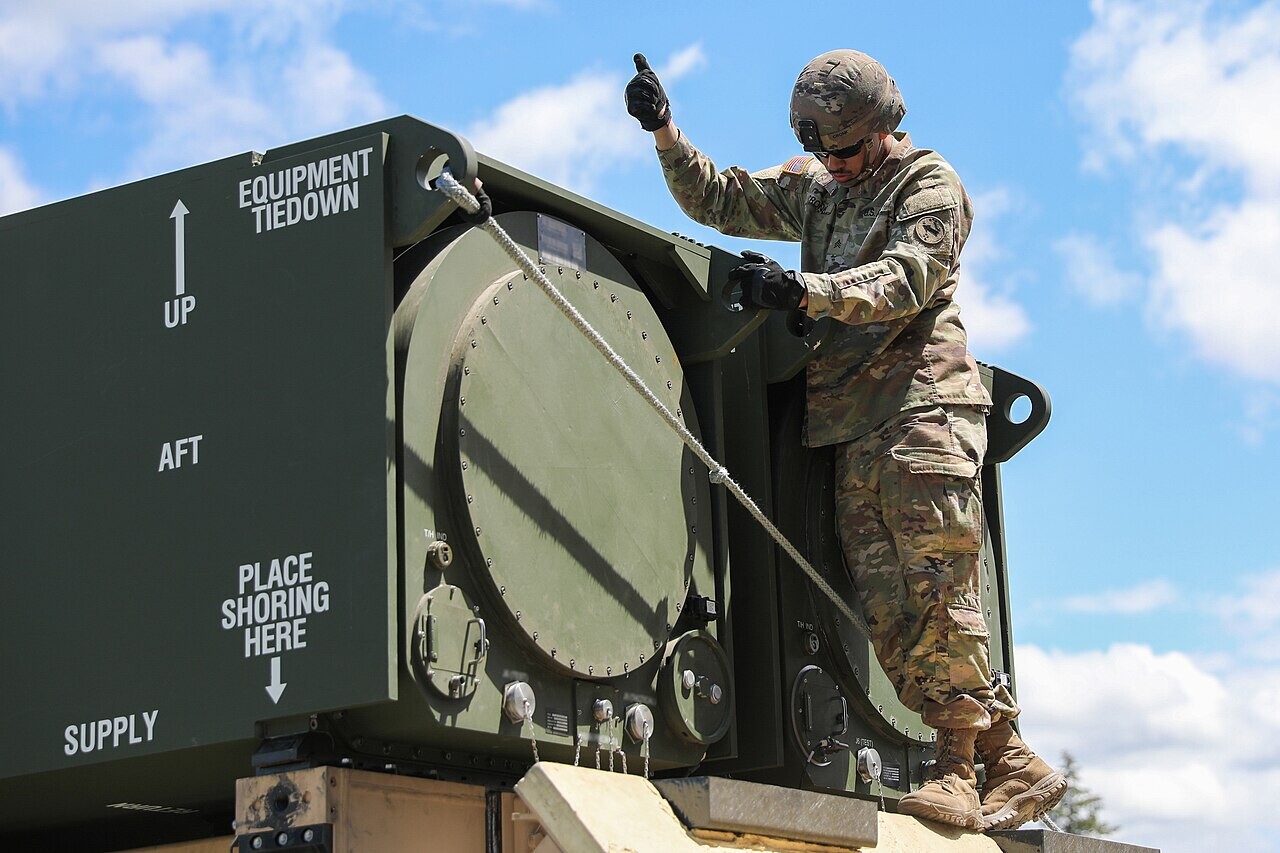
Germany will receive the newest American Dark Eagle missiles, and they will be hypersonic
Russian Defense Minister Andrei Belousov, during a meeting with permanent members of the Security Council of the Russian Federation chaired by Vladimir Putin, publicly drew attention to the possible deployment by the United States of intermediate-range missile systems such as the Dark Eagle both in Europe and the Asia-Pacific region.
Belousov expressed his belief that the United States intends to make the Dark Eagle hypersonic missile operational by the end of 2025, with subsequent deployment in Germany during 2026. According to his public statements, also reported by the press and the Tass news agency, the Dark Eagle missile, with a speed of over Mach 5 and a range of over 5,000 km, could strike targets in central Russia in six to seven minutes from German territory.
Russia interprets the potential permanent presence of these systems on German soil as a direct threat, tantamount to a new medium- and short-range arms race. Consequently, the Russian government announced that it has lifted the moratorium on the deployment of medium- and short-range missiles on its territory.
This information has been reported by national newspapers and specialized agencies. The possible deployment of the Dark Eagle in Germany is therefore currently a debated topic and considered credible by Russian and Western media, even if the final decision and operational timing could depend on political and military developments between late 2025 and 2026.
The spectre that Reagan and Gorbachev erased with their historic Euromissile agreement at the end of the 1980s returns in a new form.
Today, with hypersonic missiles (which can strike any European or Russian city in a matter of minutes), the situation appears much more serious in this regard than it did then. A crisis would not be manageable in a matter of minutes, and the risk of war caused by error , a technical malfunction, or a misunderstanding exponentially increases.
The deployment of the Dark Eagles would be a symmetrical deployment of the Oreshniks , the newest Russian hypersonic missiles.
The Euromissiles that the US initially announced for deployment in Germany in 2026 were of the cruise type (Tomahawk with a speed of 880 km/h). Now the scenario has completely changed.
It is urgent that the peace movement be informed and mobilize.
A petition has already been launched, signed by Alex Zanotelli among others:
https://www.peacelink.it/euromissili
But today the situation is rapidly changing and 2026 is getting dangerously close.
Every step towards European "security" with hypersonic missiles is a gamble towards the abyss.
Now more than ever, military security must be built in a shared and agreed-upon way, as Reagan and Gorbachev were able to do.
Articoli correlati
 Berlino diventa il baricentro del riarmo europeo e il progetto ELSA fa il resto
Il ritorno degli euromissili: la Germania compra, gli USA vendono, l'Europa si riarma
L'accordo USA-Germania del vertice NATO di Washington del 2024 prevedeva lo schieramento di missili americani a media gittata in Germania a partire dal 2026. Un anno dopo, ad Ankara, quell'intesa è stata stravolta: la Germania non ospiterà più missili USA in "prestito", ma li acquisterà in proprio.10 July 2026 - Redazione PeaceLink- Scheda tematica
Euromissili
La crisi degli euromissili dominò gli anni '80, quando la NATO decise di installare i missili Cruise e Pershing II in Europa in risposta ai missili sovietici SS-20. Oggi, con il venir meno del trattato INF, rischiano di ritornare, aumentando il rischio di guerra nucleare per errore.3 July 2026 - Redazione PeaceLink  An initiative by Anti-War Aotearoa and Greenpeace
New Zealand mobilises: on 20 June, a major march for peace
New Zealand pacifists are calling on Prime Minister Christopher Luxon and the government to reject military agreements with the United States and not to send troops, funds, or information in support of their wars. Another issue in the public debate is the transit of nuclear-powered submarines.7 June 2026 - PeaceLink staff The story of the F-35s that Switzerland has purchased based on secret criteria
Even the Swiss have been duped
A murky tender has crowned the US F-35 fighter jet as the winner, turning Switzerland from a neutral country into one dependent on exclusive US technology. And now there aren't enough funds to purchase the 36 aircraft agreed at a "fixed price".4 June 2026 - PeaceLink staff


sociale.network