The Black Sea as a battleground: the escalation that paralyses grain and oil
Here is the chronological sequence of events. Ukrainian attacks on Russian tankers (17-20 July): Ukraine has intensified its attacks against the Russian "shadow fleet". On 17 July, a tanker was damaged by drones while approaching the terminal of the Caspian Pipeline Consortium (CPC) near Novorossiysk. Between 19 and 20 July, President Zelensky confirmed that Ukrainian forces struck two tankers and four Russian merchant ships in the Black Sea. The Russian response (20-22 July): Russia responded with a series of targeted attacks against Ukrainian port infrastructure and merchant ships. From the Russian perspective, this was a direct response to the attacks suffered. Between 20 and 22 July, the Russian army struck several ships, including the bulk carrier Golden Rose, and continued to bombard Ukrainian ports. The suspension of ships (22 July): it was at this point that shipowners, faced with the escalation of violence and security risks, made the autonomous decision to suspend calls. As stated by Minister Vysotskyi, from 22 July ships have temporarily ceased calling at Ukrainian ports. 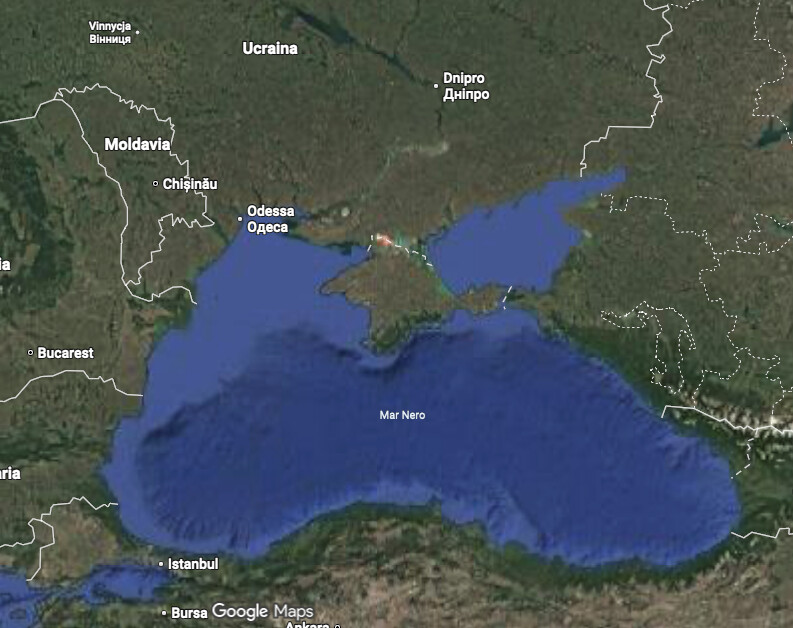 In recent days, a spiral of mutual attacks has paralysed shipping traffic in the basin, with devastating consequences for Ukrainian agricultural exports and for the Russian economy itself. The dynamics are now clear: on one side, Ukraine seeks to strike the so-called 'shadow fleet' of Russia and the energy infrastructures that fuel Moscow's war machine; on the other, Russia intensifies bombings on Ukrainian ports and merchant ships to make maritime trade from Kyiv unsustainable.
The Ukrainian offensive against the 'shadow fleet'
At the beginning of July, Ukraine launched a systematic campaign of attacks against the ships of the so-called 'shadow fleet' of Russia, a network of often outdated tankers and cargo ships registered under flags of convenience, used by Moscow to evade Western sanctions and continue exporting oil. According to Ukrainian military sources, over a hundred ships have been struck since the beginning of the month between the Sea of Azov and the Black Sea.
President Volodymyr Zelensky personally announced that two tankers from the shadow fleet and four merchant ships in the Black Sea had been hit. At the same time, Ukrainian forces have extended their reach to logistical infrastructures and oil depots in the Moscow region. The declared objective is twofold: to reduce oil revenues that finance the Russian war effort and to isolate occupied Crimea by disrupting supplies by sea.
The Russian response: paralysed Ukrainian ports
Moscow's reaction was swift. Starting from 20 July, Russia intensified missile and drone attacks against Ukrainian ports in the Black Sea and against merchant ships in transit. On 20 July, a missile attack on a ship carrying corn near Odessa killed ten people among the crew and port staff. In the following nights, Russian Geran missiles struck at least four vessels heading towards Ukrainian ports.
The escalation had an immediate effect: on 22 July, the Ukrainian Minister of Agrarian Policy and Food, Taras Vysotskyi, declared that ships had temporarily suspended calls at Ukrainian ports. A decision not imposed by the state, but taken autonomously by shipowners, frightened by the increased risk and skyrocketing insurance premiums. On 23 July, reportedly, no ships transited through the Ukrainian grain corridor. The Danish multinational Maersk diverted cargo traffic to the Romanian port of Constanța.
Kiev's decision to escalate the confrontation in the Black Sea by attacking the Russian "shadow fleet" is a high-risk strategic gamble. The potential benefits are significant, but they have immediately been accompanied by equally severe and immediate costs. In summary, it cannot be said that it has been in Kiev's interest, as the collateral damage to its own economy has been enormous and almost simultaneous. Let us examine the two sides of the coin in detail. The Ukrainian escalation has been motivated by broad military and economic objectives: Suffocate the Russian war economy: by targeting the refineries and tankers of the "shadow fleet", Kiev aimed to reduce Moscow's oil revenues and create fuel shortages. The attacks have already reduced Russian petrol production to 65% of seasonal needs and have caused pump prices to rise by 40%. Isolate Crimea: the peninsula, occupied by Russia, has become a priority target. Attacks in the Sea of Azov and the Black Sea aim to disrupt maritime supplies of fuel and materials. This pressure has already forced pro-Russian authorities in Crimea to ration petrol. Deliver an unprecedented blow: according to experts, the Ukrainian campaign of July 2026, with over 100 ships hit in a few days, represents one of the most intense attacks on civilian shipping in modern history. However, the Russian response has been swift and has struck Ukraine at its most vulnerable point: agricultural exports. Paralysis of Ukrainian exports: in response, Russia has intensified attacks on Ukrainian ports and merchant ships. The result has been a total blockade of maritime traffic in Ukrainian ports, with zero ships passing through the grain corridor. Loss of export capacity: Ukraine has lost about a third of its capacity to export grain by sea, just at the height of the harvest season. Autonomous decision by shipowners: as highlighted by Minister Vysotskyi, the suspension of calls has not been imposed by Kiev, but is an autonomous decision by shipowners, frightened by the increased risk and skyrocketing insurance premiums. This demonstrates that the escalation has frightened Kiev's trading partners, effectively paralyzing its economy. Damage to image and request for help: The gravity of the situation is such that Ukraine has had to request an urgent meeting of the UN Security Council, denouncing Russia's "economic and humanitarian terror". Ultimately, the Ukrainian escalation has turned the Black Sea into a battlefield where both sides are suffering enormous damage. While Kiev has managed to inflict a significant blow to the Russian economy and disrupt the logistics of Crimea, it has also triggered a reaction that has effectively blocked its own main export route, with devastating consequences for its economy and global food security. The move has triggered a dynamic of mutual economic destruction that, at present, seems to have penalised at least as much, if not more, Ukraine itself, making the strategic balance of this operation, for Kiev, extremely dubious and costlyKiev's reasons: potential strategic benefits
The price paid: immediate and devastating costs
Conclusion
Economic effects: mutual damage
The economic consequences of this escalation are already tangible and severe for both contenders.
For Ukraine, the paralysis of Black Sea ports represents a severe blow. The country has lost about a third of its capacity to export grain by sea, just at the height of the harvest season. Agricultural exports are one of the few sources of hard currency for Kyiv, and the blockade risks having devastating repercussions on the country's economy.
Russia, however, is also suffering significant backlash. The port of Novorossiysk, the main Russian hub on the Black Sea by volume of goods, has introduced a night navigation ban due to the threat of Ukrainian drones. According to estimates, Russia's export capacity has decreased by a quarter. Prices for European wheat have surged by 7%, fuelling fears over major export routes.
The spectre of a global food crisis
The Black Sea is one of the most important corridors in the world for agricultural exports. The disruption of trade flows in this area, combined with other global crises such as tensions in the Strait of Hormuz, risks triggering a new global food crisis, with potentially dramatic consequences for countries in Africa, the Middle East, and Asia that depend on supplies of Ukrainian and Russian grain.
Ukrainian Foreign Minister Andrii Sybiha condemned the Russian attacks as 'deliberate economic and humanitarian terror' and called for an urgent meeting of the UN Security Council for 27 July.
Russia has rejected the accusations of 'economic and humanitarian terror', turning them back against Ukraine and justified its attacks as legitimate self-defence. The Russian Foreign Minister, Sergey Lavrov, had already described Ukrainian actions in the Sea of Azov and the Black Sea as 'pure terrorism', claiming that Kyiv's attacks aim to 'simply cause damage and intimidate', even surpassing the logic of piracy. This line has been reiterated by the spokesperson for the Russian Foreign Ministry, Maria Zakharova, who spoke of a 'joint crime' by Kyiv and the West
A dangerous spiral
This escalation in the Black Sea represents a qualitative leap in the armed conflict. What began as a predominantly land war is transforming into a battle for control of maritime routes, with consequences that go far beyond the two countries involved.
Kyiv's choice to attack the Russian shadow fleet has triggered a chain reaction that is paralysing its own economy.
As highlighted by Ukrainian Minister Vysotskyi, the suspension of calls has not been imposed by Kyiv, but is a autonomous decision by shipowners, frightened by the increased risk and skyrocketing insurance premiums. This demonstrates that the escalation has frightened Kyiv's trading partners, effectively paralysing its economy.
Counterproductive effects for Ukraine
In summary, it cannot be said that it has benefited Kyiv to escalate the confrontation in the Black Sea, as the collateral damage to its own economy has been enormous and almost simultaneous. See in the second in-depth box on this webpage.
Kyiv's move has triggered a dynamic of mutual economic destruction that, at the moment, seems to have penalised at least as much, if not more, Ukraine itself, making the strategic balance of this operation for Kyiv extremely dubious and costly. Predictably, the effects on the civilian economy will be extremely high.
In this context, the Black Sea confirms itself as one of the most dangerous and unpredictable theatres of war. The international community faces a difficult choice: how to cool the conflict that risks turning a sea of trade into a sea of conflict, with incalculable human and economic costs for all.
Articoli correlati
 L’estate del 2026 sta segnando una svolta pericolosa nel conflitto russo-ucraino
Il Mar Nero come campo di battaglia: l’escalation che paralizza grano e petrolio
Il Mar Nero, da sempre arteria commerciale vitale per entrambi i paesi, si è trasformato in un teatro di guerra dove si intrecciano attacchi militari, ritorsioni economiche e una crescente minaccia alla sicurezza alimentare globale.23 July 2026 - Redazione PeaceLink Violenze e torture su renitenti e disertori
Il prezzo dei "successi militari" di Kiev
Un'enorme pressione si è scaricata sui soldati ucraini dei reparti punitivi d'assalto. La retorica occidentale della presunta "svolta" sul campo di battaglia si conferma per l'ennesima volta una narrazione tossica che alimentata il tritacarne umano.19 July 2026 - Redazione PeaceLink Albert, international pacifist bulletin
Ukraine: the uprising of the squares against the military "meat grinder"
The sacking of popular Defence Minister Fedorov has sparked unprecedented protests in Kyiv and other Ukrainian cities. At the heart of the anger from protesters and the families of soldiers is the strategy of Commander-in-Chief Syrskyi, accused of sacrificing too many human lives.18 July 2026 - Redazione PeaceLink- Albert, bollettino pacifista internazionale
Ucraina: la rivolta delle piazze contro il "tritacarne" militare
Il siluramento del popolare ministro della Difesa Fedorov accende proteste senza precedenti a Kiev e in altre città ucraine. Al centro della rabbia dei manifestanti e dei familiari dei soldati c'è la strategia del Comandante in Capo Syrskyi, accusato di sacrificare troppe vite umane.18 July 2026 - Redazione PeaceLink


sociale.network