"Historical experiment", Ukrainian drones can be remotely controlled from NATO territory
Only by studying the technical details of the new drones can one glimpse an unprecedented risk of escalation in the war in Ukraine. PeaceLink has conducted research on the incredible potential of Wild Hornets, a Ukrainian company that can transfer drone control from two thousand kilometres away, with full interoperability with NATO standards. The technology for a war in Ukraine managed remotely from the NATO JATEC centre in Poland is ready.
The technology is ready; only the political decision for actual NATO involvement - secret or overt - in the remote war is lacking.
If you still think that a Ukrainian drone is controlled from Ukraine by a Ukrainian operator, you are very much behind. Here is what we discovered in this investigation.
The experiment of Marian Zablotskyi
The technological war in Ukraine has reached a point of no return. It is no longer just about faster or cheaper drones, but about a silent revolution concerning remote control: the signal guiding an interceptor drone no longer travels only via radio, but through ground stations and internet connections, making the identity and location of the pilot virtually untraceable by the enemy.

A recent historical experiment conducted by Marian Zablotskyi, a Ukrainian MP and contracted drone pilot in the territorial defence forces, has demonstrated that an interceptor drone Sting can be guided from a distance of 2,000 kilometres while the operator is abroad and the drone patrols the skies of northern Ukraine .
“I piloted an FPV interceptor drone first from my office, then from the state border, and finally from about 2,000 km away from the drone itself, from abroad” – declared Zablotskyi, describing the operation as a “historical experiment” and a decisive factor in stopping the Russian offensive .
The experiment by Ukrainian MP Marian Zablotskyi, who controlled an FPV interceptor drone from a distance of about 2,000 km, was conducted between 14 and 20 April 2026. Zablotskyi announced the experiment on social media on 21 April 2026. In the same announcement, he stated that he had conducted it "last week".
"Being 2,000 km away from the drone — outside Ukraine — I was able to fully control the device," Zablotskyi emphasised.
The invisible architecture of remote control
The technology that makes this operational deployment outside Ukraine possible (while the drone takes off from Ukraine) is Hornet Vision Ctrl, developed by the Ukrainian company Wild Hornets. The Ukrainian Ministry of Defence has already coded the system according to NATO standards, making it officially operational.
The technical operation is relatively linear but extraordinary in its implications.
-
The drone takes off from Ukraine and communicates with a ground station via a low-latency digital radio channel.
-
The ground station connects to the internet (via systems like Starlink) to transmit the video signal and control commands. This allows the operational control of the drone to be passed to an operator abroad.
-
The pilot, physically located outside Ukraine, connects to the network and operates as if they were in Ukraine, on the battlefield. It is therefore technically feasible for a NATO operator to direct an attack on Russian soldiers and vehicles from Poland using a drone launched from Ukraine.
The result, in summary, is that the operator is no longer tied to a specific geographical location: they can be in a safe city in another European country while the drone strikes Russia. And Russia could not strike the NATO centre outside Ukraine, where the opposing drone operator is operating, because this would trigger Article 5 of the NATO Treaty, leading to a world war.
The issue is currently theoretical but represents an extremely high-risk profile for the secrecy with which drone control can be transferred from Ukraine to NATO. And NATO could always deny being fully involved as there would be no confirmation of who actually controls the drone, whether a Ukrainian operator or a NATO operator. It could also be a Ukrainian operator hosted by a NATO country, assisted by the JATEC centre, a joint Ukraine-NATO centre located in Poland.
An exponential evolution in a few months
The speed at which this new technology has evolved is impressive.
-
Early March 2026: the system operated at a distance of about 36 km.
-
Early April 2026: the pilot Roman, codename “Hulk” of the Bulava unit, shot down two Russian Shahed drones from a distance of 500 km, an absolute world record described as the first case in which an operator intercepts multiple drones at such a distance.
-
Mid-April 2026: the leap to 2,000 km confirms a growth of 55 times in less than two months .
The progression suggests an exponential improvement in signal stability and latency reduction, the main technical challenge of these systems. Reducing latency means making a system more responsive. The latency is the time delay between a command (input) and the visual or executive response.
The strategic impact: pilots safe, drones at war
The crucial aspect, as highlighted by the Ukrainian Ministry of Defence itself, is that drone pilots have become a priority target for Russian forces. Physically relocating them away from the front line drastically reduces the risk to personnel.
“The pilot is no longer tied to a specific position. The drone is in the sky, controlled from a safe environment in Kyiv, Lviv or even abroad” – stated former Ukrainian Defence Minister Mykhailo Fedorov .
According to data provided by Wild Hornets, in less than three months of use, the system Hornet Vision Ctrl has enabled the destruction of over 600 aerial targets, including Shahed drones in their jet version. The technology is already in serial production and field distribution.
Beyond the battlefield: implications for the future
This innovation raises questions. The ability to geographically dissociate the operator from the drone makes attributing military action complex and, in some scenarios, virtually unverifiable on the ground.
As a representative of Wild Hornets noted to Business Insider, the company is working to make it possible to control drones from another continent, not just from another country.
War is transforming: the boundary between those who fight and those who support, between those who are at war and those who are safe, is becoming increasingly blurred. The line between Ukraine and direct NATO involvement in conducting remote operations is shrinking to the point of disappearing if a Ukrainian drone operator - perhaps in difficulty - hands control to a NATO drone operator located thousands of kilometres away.
Co-belligerence
International doctrine specifies that one is co-belligerent when the support provided to one of the warring parties exceeds a certain threshold, making the state providing assistance an integral part of the armed conflict.
The crucial question we must ask is: "Is the pilot guiding the Ukrainian drone from abroad a member of the armed forces of a NATO state and conducting an attack on Russian armed forces?". If the answer is yes, the NATO state is directly participating in hostilities.
Risk of direct NATO-Russia confrontation
The legal consequences are significant: in this scenario, NATO personnel would become a legitimate military target, exposing the NATO state to the risk of being considered a belligerent party in the conflict.
But since NATO can always deny having taken control of the drone (proving it is extremely complex if not impossible), this could trigger the NATO collective military response against Russia. This is precisely what the Ukrainian government has long hoped for.
The Zablotskyi case is the visible tip of a new operational doctrine that is nullifying the boundary between Ukrainian territory and NATO territory. This dissolution is technologically irreversible and politically explosive. It could indeed transform a proxy war into a direct conflict between NATO and Russia, with all the nuclear implications that entails. The threshold of global security from this perspective is lowering week by week.

Articoli correlati
 Albert, bollettino pacifista internazionale
"Esperimento storico", droni ucraini possono essere teleguidati dal territorio della NATO
E' possibile colpire la Russia facendo decollare droni dall'Ucraina e guidandoli dalla Polonia? La tecnologia è pronta e Marian Zablotskyi, parlamentare ucraino, l'ha sperimentata: "Ho pilotato un drone dall’estero". Lo scontro militare NATO-Russia rischia di diventare diretto e catastrofico.23 August 2026 - Redazione PeaceLink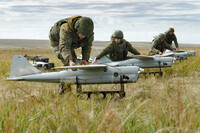 L’aeronautica riceve dai droni le coordinate per guidare le terribili bombe plananti
La guerra dei droni russi: 87 mila uomini e la nuova profondità del campo di battaglia
L'Institute for the Study of War ha documentato operazioni dei droni russi nelle retrovie del fronte contro veicoli, autocisterne, mezzi logistici, posti di comando e altri obiettivi lungo strade e ferrovie anche a decine di chilometri dalla linea di contatto.23 August 2026 - Redazione PeaceLink Italia alle Hawaii per l'esercitazione navale Pacific Dragon 2026
Perché stiamo uscendo dallo spazio NATO?
Non è la prima volta che PeaceLink solleva questo allarme. Già nel 2024, in occasione dell'esercitazione Pitch Black in Australia, avevamo denunciato come la partecipazione italiana fuoriesca completamente - in funzione anticinese - dall'area geografica per cui è stata istituita la NATO.22 August 2026 - Redazione PeaceLink Cosa c'è di vero?
La Finlandia sospetta che un velivolo russo abbia violato il suo spazio aereo
Il 20 agosto 2026, il Ministero della Difesa della Finlandia ha denunciato lo sconfinamento di un velivolo russo all'interno del proprio spazio aereo sovrano. L'episodio, avvenuto nell'area costiera della cittadina di Provoo, è avvenuto in un punto del Golfo di Finlandia molto stretto.22 August 2026 - Redazione PeaceLink


sociale.network