Second day of nuclear exercises over our heads
What's happening above our heads?
We are on the second day of the NATO nuclear exercise Steadfast Noon 2026.
Today we will see the military bases from which the fighter-bombers take off and other details of this exercise simulating a "nuclear strike" scenario.
When the exercise started
It began on the morning of October 13th and will last ten days. It's called Steadfast Noon, codenamed "resolute noon," and it's the annual exercise through which NATO trains crews, procedures, and chains of command to use the American tactical nuclear bombs deployed in Europe.
The role of Italy
This year, it is Italy's turn to host the exercise, as it did in 2023.
The news did not come from a government announcement, but from a press release by PeaceLink, which released a technical document for pilots: the AIRAC S56/26 supplement to AIP Italia, published by ENAV on August 20.
From there, many news outlets picked it up.
The parliamentary question
Green and Left Alliance MP Angelo Bonelli has announced a question to Defense Minister Guido Crosetto, arguing that Parliament and the public have a right to know. The minister's response, so far, is that this is an annual training exercise, long-planned and hosted by Italy six times already under governments of different political persuasions.
The five bases from which the flights depart
The ENAV document lists the bases from which aircraft will take off bound for training areas in the Tyrrhenian Sea and along the corridors that cross the peninsula: Ghedi, in Lombardy; Aviano, in Friuli-Venezia Giulia; Amendola and Gioia del Colle, in Puglia; and Trapani, in Sicily. The dates of the main activities are four: October 13, 14, 16, and 20. The map attached to the document depicts corridors that descend from Friuli and the Lombardy plain following the Tuscan-Emilian Apennines, head west from Puglia, and ascend the Tyrrhenian Sea from western Sicily. In between is Sardinia, overflown up to approximately 1,800 meters in the area known as Star 5, which encompasses part of the interior and the eastern coast, including the Salto di Quirra range. The document speaks of "intense military air activity, firing, and the use of drones."
Ghedi and Aviano: the two atomic bomb bases
Ghedi, in the province of Brescia, is home to the 6th Wing of the Italian Air Force. Aviano, in Friuli, is a base for the Italian Air Force and the US Air Force. These are the two Italian bases where, according to independent sources such as the Federation of American Scientists and the Bulletin of the Atomic Scientists, US B61-12 tactical nuclear bombs are stored as part of the NATO nuclear sharing program. Estimates suggest approximately 20-30 warheads at Aviano and 10-15 at Ghedi, for a total of approximately 35, the highest number among European Union countries.
The Tornados of the 6th Wing, aircraft historically certified for nuclear duty, take off from Ghedi. Il Giornale di Brescia clarified—as PeaceLink had already done—that the Italian F-35As are participating in the exercise but will not participate in the nuclear strike simulation because they have not yet been certified for that role. Germany has deployed three Tornados from the 33rd Tactical Wing to Aviano, accompanied by several dozen military personnel.
What are they training for?
Steadfast Noon doesn't involve the use of real nuclear weapons. Instead, it uses practice bombs without warheads, known as "mock bombs." But the entire cycle is reproduced: alert, transport of the bombs from underground storage, assembly on fighters, takeoff, simulated attack, and reentry. Procedures, chains of command, supplies, and in-flight refueling are rehearsed.
NATO's nuclear policy chief, Nassima Barrows, clarified that this is a "full-fledged" nuclear exercise, adding that she fully agrees with Rome on this definition.
France remains outside, consistent with its historic choice not to join NATO's Nuclear Planning Group.
The political case
The affair has taken on a political dimension. The Honorable Angelo Bonelli stated that he learned of the exercise "from the pilots' bulletin" and not from the government, and described Sardinia's involvement as particularly serious, "once again treated as a military servitude." The Star 5 area includes the Salto di Quirra testing range, where the population has been demanding truth and cleanup for years. Bonelli also called for Italy to join the UN Treaty on the Prohibition of Nuclear Weapons and the removal of warheads from national territory. Defense Minister Guido Crosetto's response was clear: it is an annual, long-planned training exercise that rotates among Alliance countries, and which Italy has already hosted in 2010, 2013, 2014, 2018, 2021, and 2023.
Cross-referenced data on B61-12s in Italy
Independent estimates of the presence of B61-12 nuclear bombs in Europe indicate approximately 100 units distributed across six NATO bases. The distribution includes 10-15 bombs each at Büchel in Germany, Kleine Brogel in Belgium, Volkel in the Netherlands, and Ghedi in Italy, and 20-30 bombs each at Aviano in Italy and Incirlik in Turkey. The Nuclear Weapons Ban Monitor 2024 report, cited by several newspapers, estimates 20-30 warheads at Aviano and 10-15 at Ghedi. Washington, as is its practice, neither confirms nor denies.
Tornado Technical Data Sheet
- Technical characteristics: the Tornado PA-200 is a twin-engine, two-seater, all-weather fighter-bomber, famous for its variable geometry wing . This configuration allows it to vary the sweep of the wings in flight: open wings for take-off or for low-altitude flying following the contours of the ground, and completely folded back wings to reach high supersonic speeds. [ 1 , 2 ]
- The nuclear mission: in the context of the NATO doctrine of Nuclear Sharing , Italy makes available the Tornados for the transport of US tactical nuclear bombs. [ 1 , 2 ]
Glossary
AIP (Aeronautical Information Publication). Official publication of aeronautical information from a country. In Italy, it is published by ENAV.
AIRAC (Aeronautical Information Regulation and Control). Regulated cycle for publishing aeronautical information. AIRAC supplements communicate temporary or permanent changes to airspace.
AWACS (Airborne Warning and Control System). Airborne surveillance and command aircraft equipped with radar capable of covering long distances.
B61-12. American tactical thermonuclear bomb, the latest version of the B61 family. It has selectable yield and is designed to be carried by dual-capable fighters.
CAEW (Conformal Airborne Early Warning). An early warning aircraft with radar mounted conformally to the fuselage.
Dual-capable. Aircraft capable of carrying out both conventional and nuclear missions.
ENAV. Company that manages civil air traffic control in Italy. Publishes the AIP and AIRAC supplements.
FAS (Federation of American Scientists). An independent U.S. organization that conducts research on nuclear transparency.
Nuclear sharing. A NATO program under which the United States stores tactical nuclear weapons on the territory of allies. In the event of a conflict, allied pilots could use them with the authorization of the US president.
OSINT (Open Source Intelligence). Intelligence based on open sources: public data, government documents, commercial satellite imagery, ADS-B tracking.
Steadfast Noon. An annual NATO exercise dedicated to nuclear deterrence. It takes place on a rotational basis among Alliance countries. It does not involve the use of actual nuclear weapons.
Tanker. A tanker for in-flight refueling. It extends the range of combat aircraft.
Tornado. Fighter-bomber in service with the Italian and German Air Forces. Historically certified for nuclear duty.
Articoli correlati
 It was presented by the Honorable Angelo Bonelli of the Greens
NATO nuclear exercise, parliamentary question
The question is whether the government has commissioned a study on the expected deaths and injuries in the event of a nuclear war on the short, medium, and long-term health impacts, and whether, in light of the data, the government intends to suspend Italy's participation in Steadfast Noon.14 October 2026 È stata presentata dall’onorevole Angelo Bonelli dei Verdi
Esercitazione nucleare NATO, interrogazione parlamentare
Si chiede se il governo ha commissionato uno studio sui morti e feriti attesi in caso di guerra nucleare, in particolare sugli impatti sanitari a breve, medio e lungo termine e se, alla luce dei dati, il governo voglia sospendere la partecipazione italiana a Steadfast Noon.14 October 2026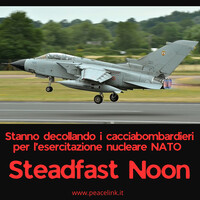 L'esercitazione NATO Steadfast Noon 2026 cronometra i decolli e simula scenari di nuclear strike
Secondo giorno di esercitazione nucleare sulle nostre teste
Steadfast Noon non prevede l’uso di armi nucleari reali. Si utilizzano bombe da esercitazione prive di testate. Ma il ciclo che viene riprodotto è quello completo: allarme, trasporto delle bombe dai depositi sotterranei, montaggio sui caccia, decollo, rifornimento in volo, attacco e rientro.14 October 2026 - Redazione PeaceLink PeaceLink writes to Defence Minister Guido Crosetto
Letter to the Italian Government regarding the Steadfast Noon nuclear exercise
We request to know what simulation studies have been commissioned regarding the civil and health effects of a nuclear war scenario and what civil emergency plans, particularly health-related ones, have been prepared.13 October 2026 - Associazione PeaceLink


sociale.network