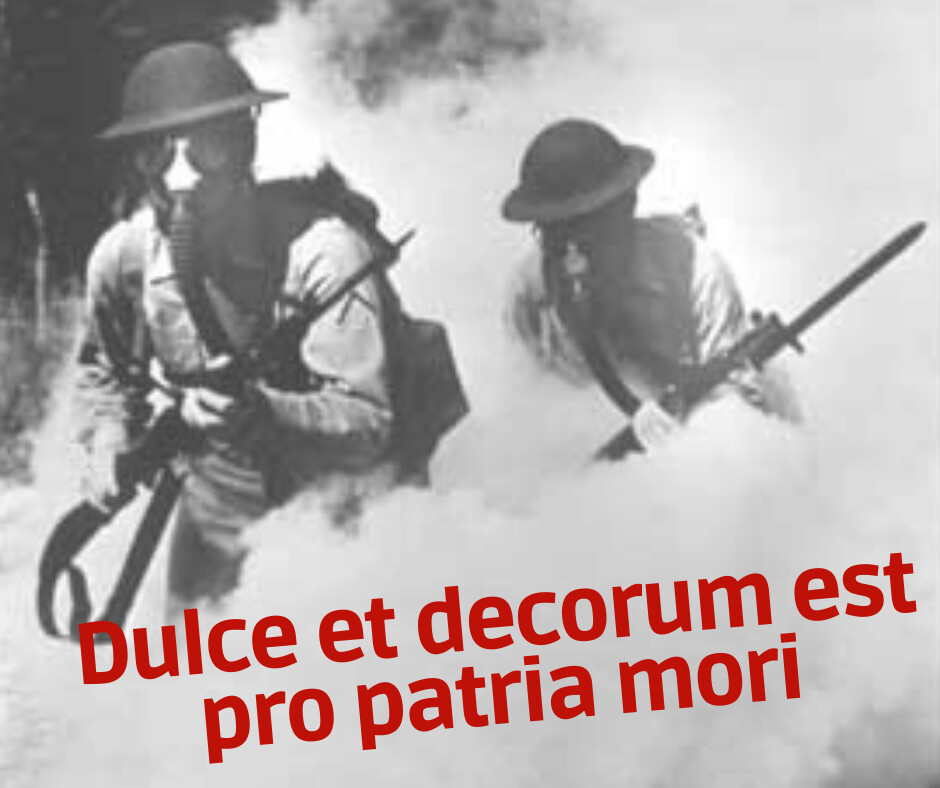
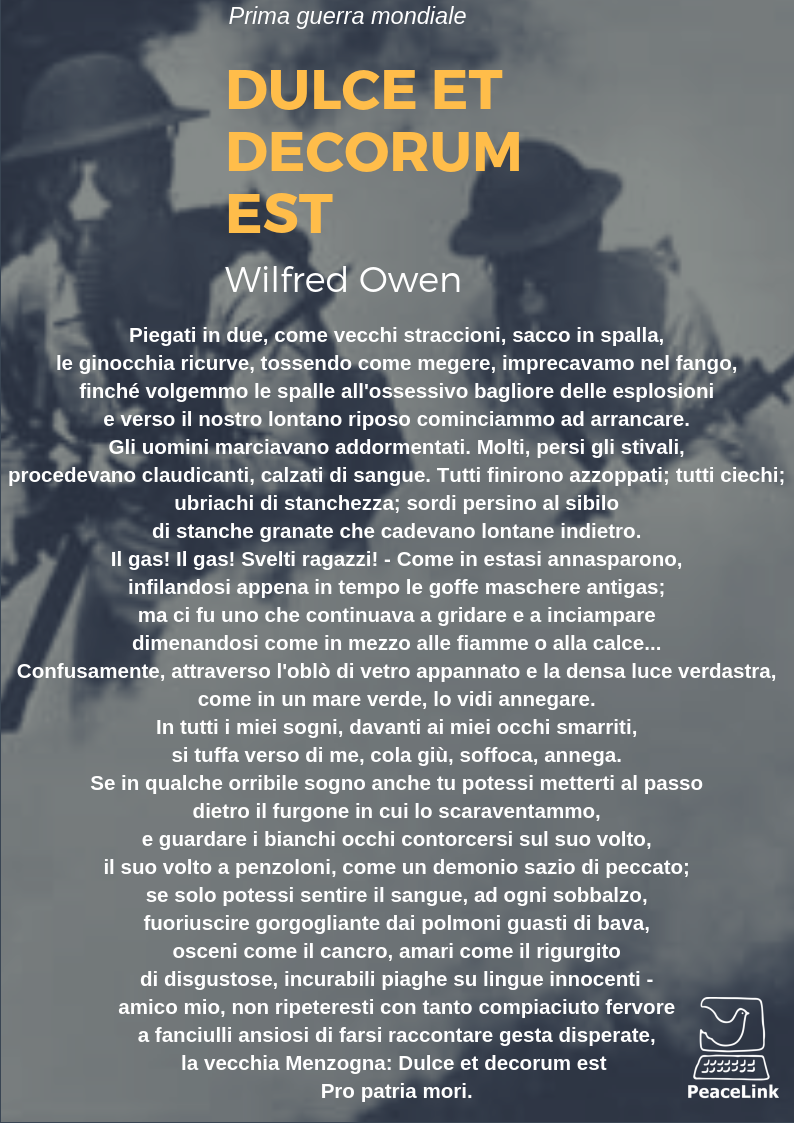
Una poesia scritta durante la Prima Guerra Mondiale dal poeta inglese Wilfred Owen, uno degli esponenti dei cosiddetti "war poets". Nella poesia scrive: "Il gas! Il gas! Svelti ragazzi! Come in estasi annasparono, infilandosi appena in tempo le goffe maschere antigas".
Wilfred Owen
Piegati in due, come vecchi straccioni, sacco in spalla,
le ginocchia ricurve, tossendo come megere, imprecavamo nel fango,
finché volgemmo le spalle all'ossessivo bagliore delle esplosioni
e verso il nostro lontano riposo cominciammo ad arrancare.
Gli uomini marciavano addormentati. Molti, persi gli stivali,
procedevano claudicanti, calzati di sangue. Tutti finirono azzoppati; tutti ciechi;
ubriachi di stanchezza; sordi persino al sibilo
di stanche granate che cadevano lontane indietro.
Il gas! Il gas! Svelti ragazzi! - Come in estasi annasparono,
infilandosi appena in tempo le goffe maschere antigas;
ma ci fu uno che continuava a gridare e a inciampare
dimenandosi come in mezzo alle fiamme o alla calce...
Confusamente, attraverso l'oblò di vetro appannato e la densa luce verdastra,
come in un mare verde, lo vidi annegare.
In tutti i miei sogni, davanti ai miei occhi smarriti,
si tuffa verso di me, cola giù, soffoca, annega.
Se in qualche orribile sogno anche tu potessi metterti al passo
dietro il furgone in cui lo scaraventammo,
e guardare i bianchi occhi contorcersi sul suo volto,
il suo volto a penzoloni, come un demonio sazio di peccato;
se solo potessi sentire il sangue, ad ogni sobbalzo,
fuoriuscire gorgogliante dai polmoni guasti di bava,
osceni come il cancro, amari come il rigurgito
di disgustose, incurabili piaghe su lingue innocenti -
amico mio, non ripeteresti con tanto compiaciuto fervore
a fanciulli ansiosi di farsi raccontare gesta disperate,
la vecchia Menzogna: Dulce et decorum est
Pro patria mori.
Dulce et decorum est pro patria mori (Owen, war poet)
Autore: PeaceLink
Note: --- Una scheda su Wilfred Owen http://it.wikipedia.org/wiki/Wilfred_Owen --- Il testo originale in inglese DULCE ET DECORUM EST(1) Bent double, like old beggars under sacks, Knock-kneed, coughing like hags, we cursed through sludge, Till on the haunting flares(2) we turned our backs And towards our distant rest(3) began to trudge. Men marched asleep. Many had lost their boots But limped on, blood-shod. All went lame; all blind; Drunk with fatigue; deaf even to the hoots(4) Of tired, outstripped(5) Five-Nines(6) that dropped behind. Gas!(7) Gas! Quick, boys! – An ecstasy of fumbling, Fitting the clumsy helmets(8) just in time; But someone still was yelling out and stumbling, And flound'ring like a man in fire or lime(9) . . . Dim, through the misty panes(10) and thick green light, As under a green sea, I saw him drowning. In all my dreams, before my helpless sight, He plunges at me, guttering,(11) choking, drowning. If in some smothering dreams you too could pace Behind the wagon that we flung him in, And watch the white eyes writhing in his face, His hanging face, like a devil's sick of sin; If you could hear, at every jolt, the blood Come gargling from the froth-corrupted lungs, Obscene as cancer, bitter as the cud(12) Of vile, incurable sores on innocent tongues, My friend, you would not tell with such high zest(13) To children ardent(14) for some desperate glory, The old Lie; Dulce et Decorum est Pro patria mori.(15) Notes on Dulce et Decorum Est 1. DULCE ET DECORUM EST - the first words of a Latin saying (taken from an ode by Horace). The words were widely understood and often quoted at the start of the First World War. They mean "It is sweet and right." The full saying ends the poem: Dulce et decorum est pro patria mori - it is sweet and right to die for your country. In other words, it is a wonderful and great honour to fight and die for your country. 2. Flares - rockets which were sent up to burn with a brilliant glare to light up men and other targets in the area between the front lines (See illustration, page 118 of Out in the Dark.) 3. Distant rest - a camp away from the front line where exhausted soldiers might rest for a few days, or longer 4. Hoots - the noise made by the shells rushing through the air 5. Outstripped - outpaced, the soldiers have struggled beyond the reach of these shells which are now falling behind them as they struggle away from the scene of battle 6. Five-Nines - 5.9 calibre explosive shells 7. Gas! - poison gas. From the symptoms it would appear to be chlorine or phosgene gas. The filling of the lungs with fluid had the same effects as when a person drowned 8. Helmets - the early name for gas masks 9. Lime - a white chalky substance which can burn live tissue 10. Panes - the glass in the eyepieces of the gas masks 11. Guttering - Owen probably meant flickering out like a candle or gurgling like water draining down a gutter, referring to the sounds in the throat of the choking man, or it might be a sound partly like stuttering and partly like gurgling 12. Cud - normally the regurgitated grass that cows chew usually green and bubbling. Here a similar looking material was issuing from the soldier's mouth 13. High zest - idealistic enthusiasm, keenly believing in the rightness of the idea 14. ardent - keen 15. Dulce et decorum est pro patria mori - see note 1 above. These notes are taken from the book, Out in the Dark, Poetry of the First World War, where other war poems that need special explanations are similarly annotated.
Il ministro della Difesa tedesco, il socialdemocratico Pistorius, ha ipotizzato davanti al parlamento un attacco russo all’Europa entro il 2029. Per Macron occorre essere pronti anche a “versare il sangue”. Ma il generale che comanda la NATO europea smentisce tutti con i dati dell’intelligence.
No sanctions have been adopted against the government of the United Arab Emirates that supports the ruthless Rapid Support Forces militias. As the United Arab Emirates are firmly linked to NATO, the sanctions concern individuals, companies, and financial networks but not the state entity.
Al vertice di Ankara la Nato ha invitato gli Emirati Arabi Uniti, nonostante siano coinvolti nella guerra in Sudan che sta provocando quello che da più parti viene definito un genocidio. Per non parlare dello Yemen.
Non risultano adottate sanzioni contro il governo degli Emirati Arabi Uniti che sostengono le spietate milizie delle Forze di Reazione Rapida. Essendo gli Emirati Arabi Uniti saldamente collegati alla NATO le sanzioni riguardano persone, società e reti finanziarie ma non l'entità statale.
 Il caso del generale Grynkewic, Comandante Supremo della NATO in Europa
 Albert, international pacifist bulletin
 Albert, bollettino pacifista internazionale


sociale.network