In Latvia, NATO shoots down a Ukrainian drone, believing it to be Russian
A NATO aircraft shot down a drone over the skies of Latvia this morning thinking it was Russian. Instead, it was Ukrainian.
This is paradoxical.
And it brings to mind other similar episodes.
Between May and June 2026, the Baltic region indeed became one of the most sensitive points of the drone war. In just a few days, Estonia and Latvia found themselves at the centre of distinct but connected episodes, with incursions into airspace, NATO alerts, mutual accusations, and a heavy political effect: the fall of the Latvian government led by Evika Siliņa.
The most serious case was on 7 May in Latvia, when at least two Ukrainian drones ended up in Latvian airspace after being diverted from their original course, according to Western accounts attributed to Russian electronic warfare. One of the aircraft struck a fuel depot in Rēzekne, causing no casualties but provoking an immediate political trauma. A few days later, on 19 May, in Estonia another Ukrainian drone was shot down by a NATO jet, in an episode that reignited the discussion about the presence of Ukrainian drones in the Baltic states, which are NATO countries.
The precedent of Rēzekne
The Latvian incident of 7 May showed how ambiguous the role of the Baltic states is - this is the accusation from Moscow - as they would be used as a launch pad to strike St. Petersburg. According to available accounts, the Ukrainian drones were directed towards targets in Russia, but their course was diverted due to Russian electronic warfare systems, resulting in a “shift” towards Latvia.
Technically, the “hijacking” can occur in several ways. The most well-known is jamming, which disrupts the satellite or control signal, rendering the drone unable to follow its programmed route. A second mechanism is spoofing, which falsifies navigation signals, potentially convincing the drone that it is elsewhere and thus causing it to veer in the wrong direction. In more complex scenarios, the combined effect of jamming and spoofing can push a drone off its original trajectory.
The political crisis
The internal impact in Latvia has been very strong. After the incident on 7 May, Prime Minister Evika Siliņa called for the resignation of Defence Minister Andris Sprūds, accused of failing to ensure a timely response and effective alert. Sprūds resigned, but his departure triggered a domino effect: his party withdrew support for the coalition, the majority collapsed, and on 14 May the Prime Minister announced her resignation.
The political point was not only the vulnerability of airspace but the idea that the state had not reacted quickly enough to a hybrid threat. In Latvia, where national security is a very sensitive issue, the episode transformed an aviation incident into an institutional crisis. It is a rare example of how a technical-military issue can become, in a matter of hours, a factor of stability or breakdown for a government.
The Estonian case
Estonia also experienced a similar episode. On 19 May, a NATO jet shot down a drone in Estonian airspace. It was a Ukrainian drone, not a Russian one.
Here emerges the most delicate operational paradox: NATO fighters are called to shoot down drones that, at the moment of decision, are not always attributable with certainty to one side or the other. In the Estonian case, the drone was treated as a threat in the airspace of a NATO country, but its “nationality” proved controversial in the initial stages.
The embarrassing discovery was the nationality of the threat.
Once it was established that the drone was Ukrainian and not Russian, Kyiv accused Moscow of having diverted one of its drones towards Estonia with electronic interference.
A lesson on the Baltics
The episodes of May and June show that the Baltic front is today a laboratory of misunderstandings, where drones, electronics, civil alarms, and propaganda combine. For Estonia and Latvia, the problem is not only to defend the border but to quickly establish who did what, with what means, and with what intentions.
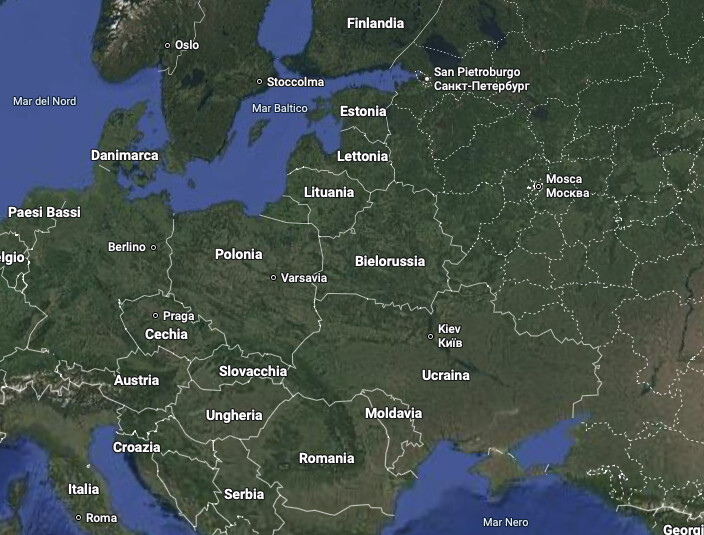
But above all, we must look at the map. We must ask ourselves: why are Ukrainian drones flying over the airspace of the Baltics? For attacks on Russia in the St. Petersburg region?
Articoli correlati
 Albert, international pacifist bulletin
Ukraine: the uprising of the squares against the military "meat grinder"
The sacking of popular Defence Minister Fedorov has sparked unprecedented protests in Kyiv and other Ukrainian cities. At the heart of the anger from protesters and the families of soldiers is the strategy of Commander-in-Chief Syrskyi, accused of sacrificing too many human lives.18 July 2026 - Redazione PeaceLink- Albert, bollettino pacifista internazionale
Ucraina: la rivolta delle piazze contro il "tritacarne" militare
Il siluramento del popolare ministro della Difesa Fedorov accende proteste senza precedenti a Kiev e in altre città ucraine. Al centro della rabbia dei manifestanti e dei familiari dei soldati c'è la strategia del Comandante in Capo Syrskyi, accusato di sacrificare troppe vite umane.18 July 2026 - Redazione PeaceLink  Il caso del generale Grynkewic, Comandante Supremo della NATO in Europa
Se i generali frenano la psicosi bellica dei politici
Il ministro della Difesa tedesco, il socialdemocratico Pistorius, ha ipotizzato davanti al parlamento un attacco russo all’Europa entro il 2029. Per Macron occorre essere pronti anche a “versare il sangue”. Ma il generale che comanda la NATO europea smentisce tutti con i dati dell’intelligence.17 July 2026 - Redazione PeaceLink Albert, international pacifist bulletin
Gaza, July 2026: the crisis continues amid bombings, hunger, and impunity
As of 17 July 2026, the most reliable quantitative data indicates that the overall Palestinian death toll in the Gaza Strip exceeds 73,000 dead and 173,000 injured since the start of the war on 7 October 2023. In July, the list of journalists killed in Gaza has grown longer.17 July 2026 - PeaceLink staff


sociale.network