"Nato assassin, go away"
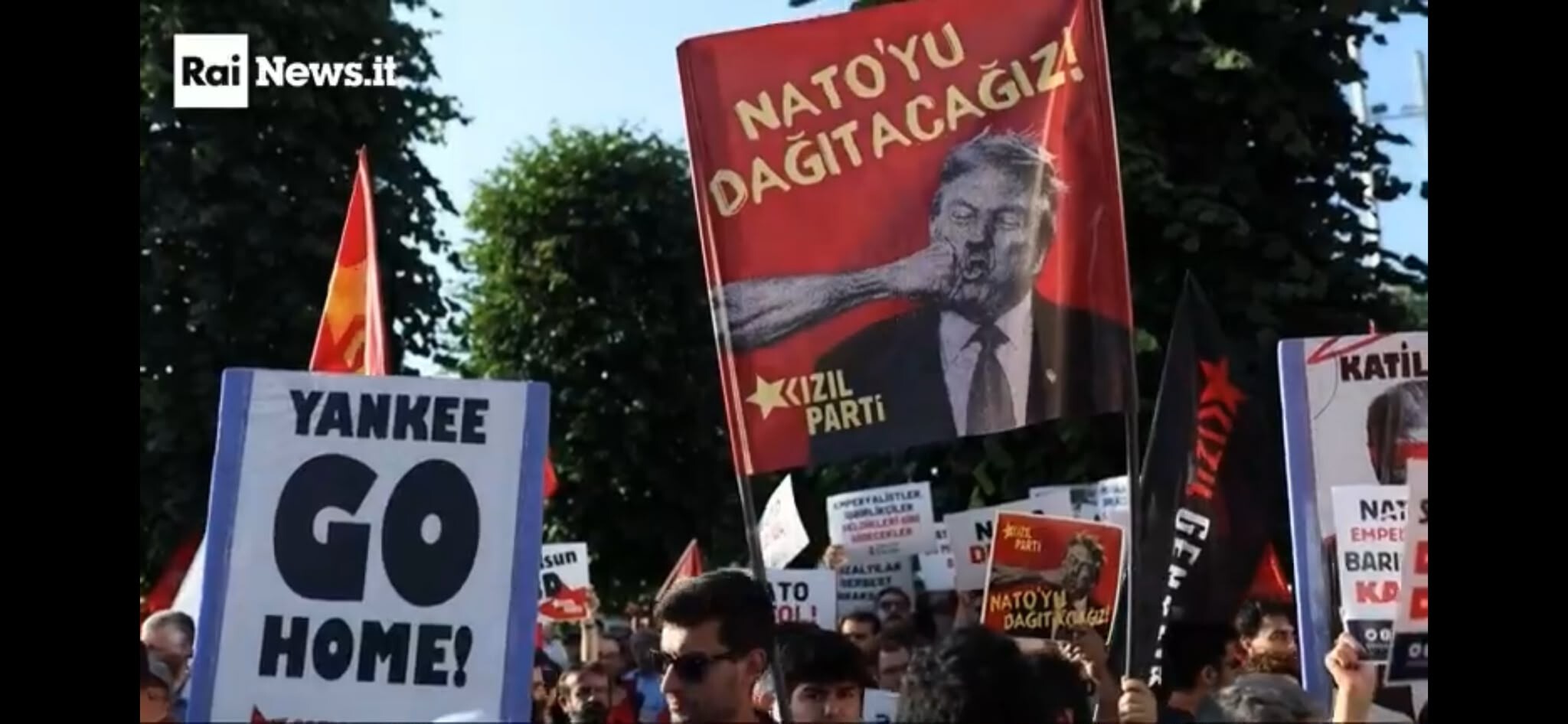
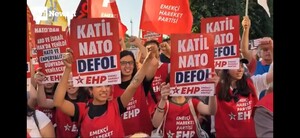 "Killer Nato, go away": protesters in the square against the Atlantic Alliance summit
Amid repression and human rights violations, the anger of the Turkish people who say "no" to Trump's imperialism and Erdogan's regime
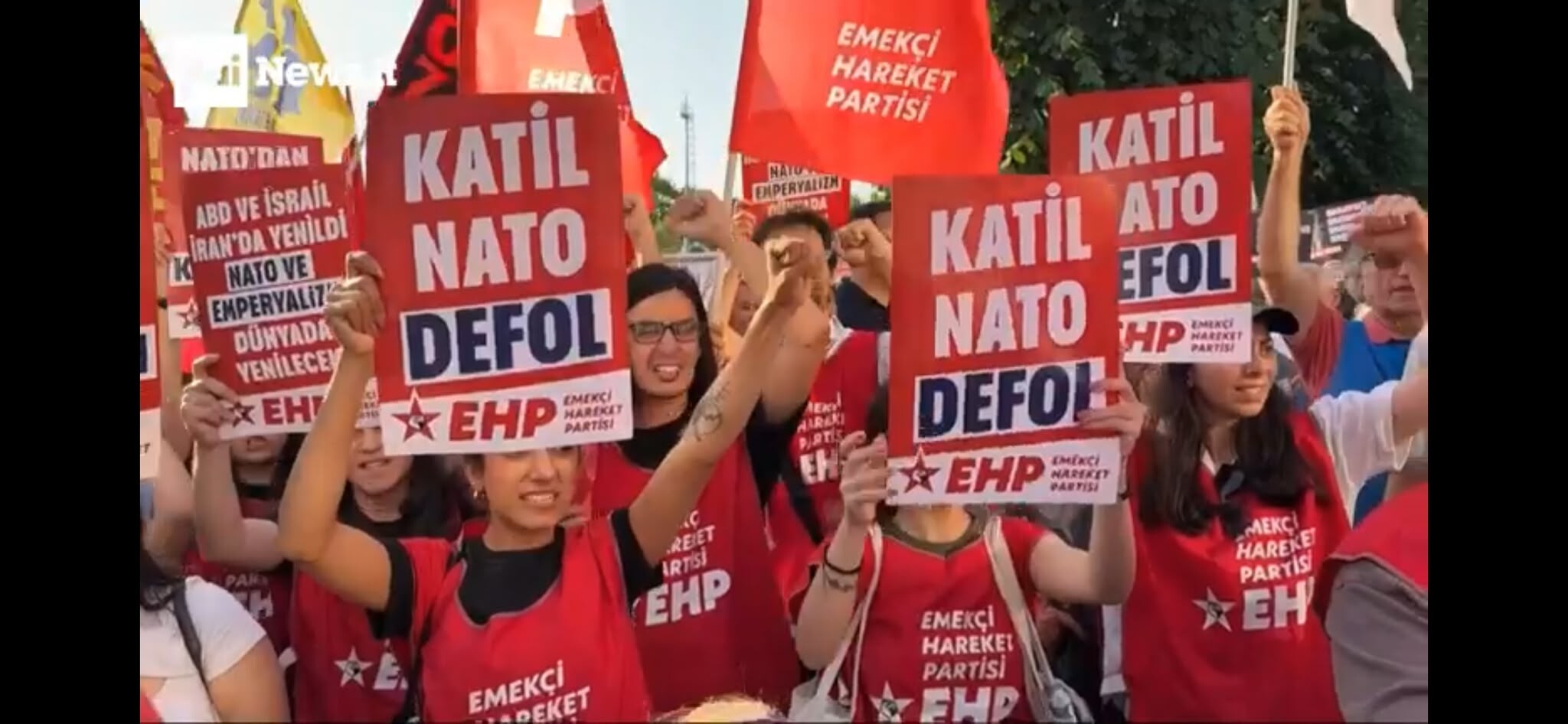
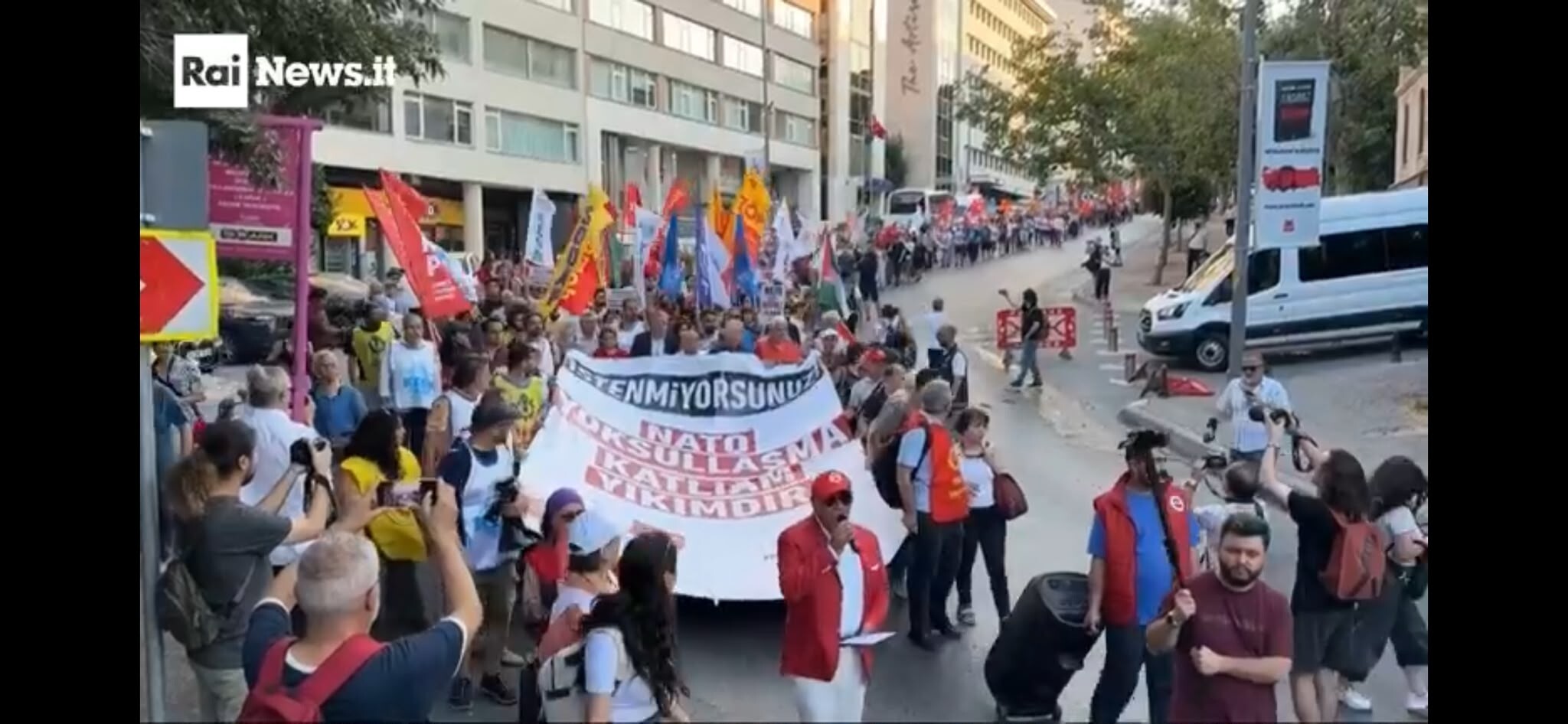
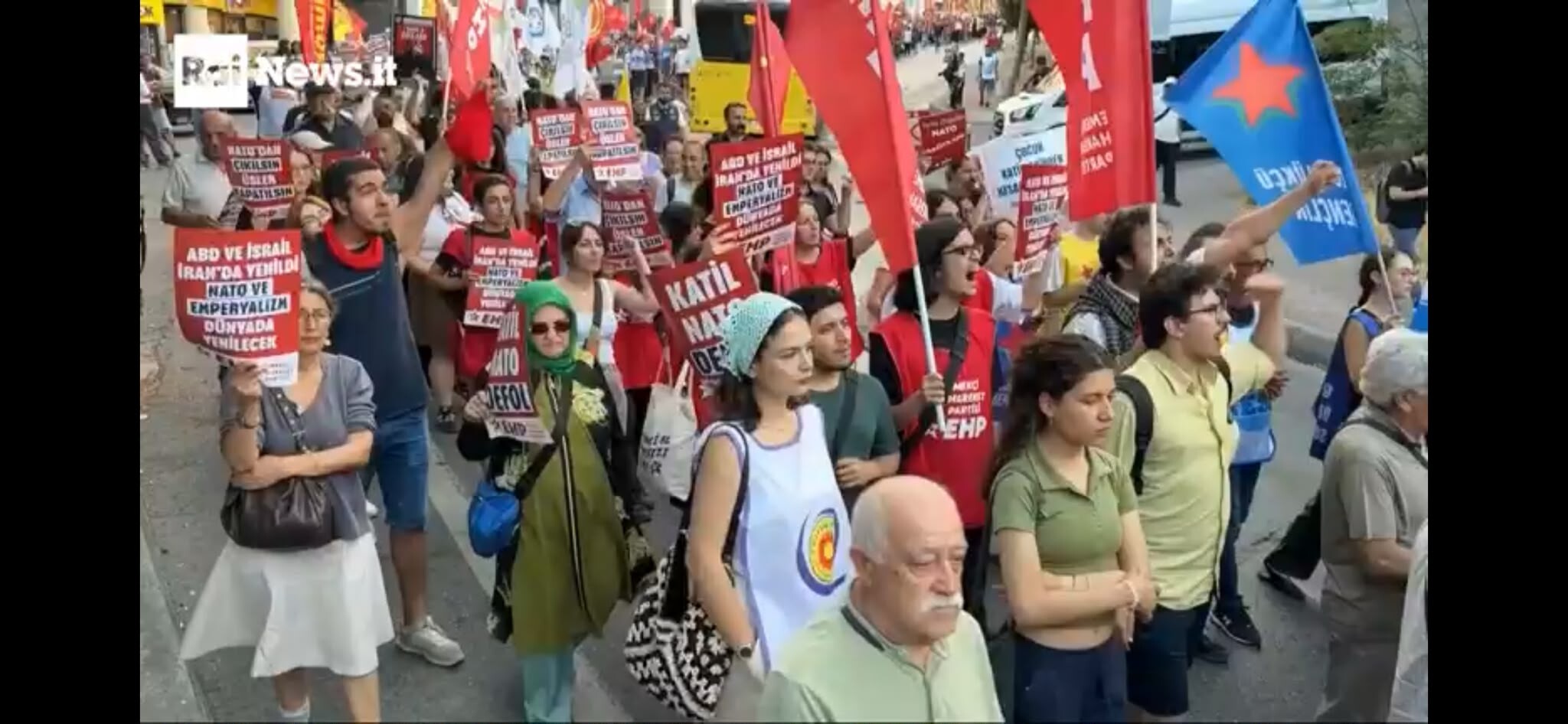
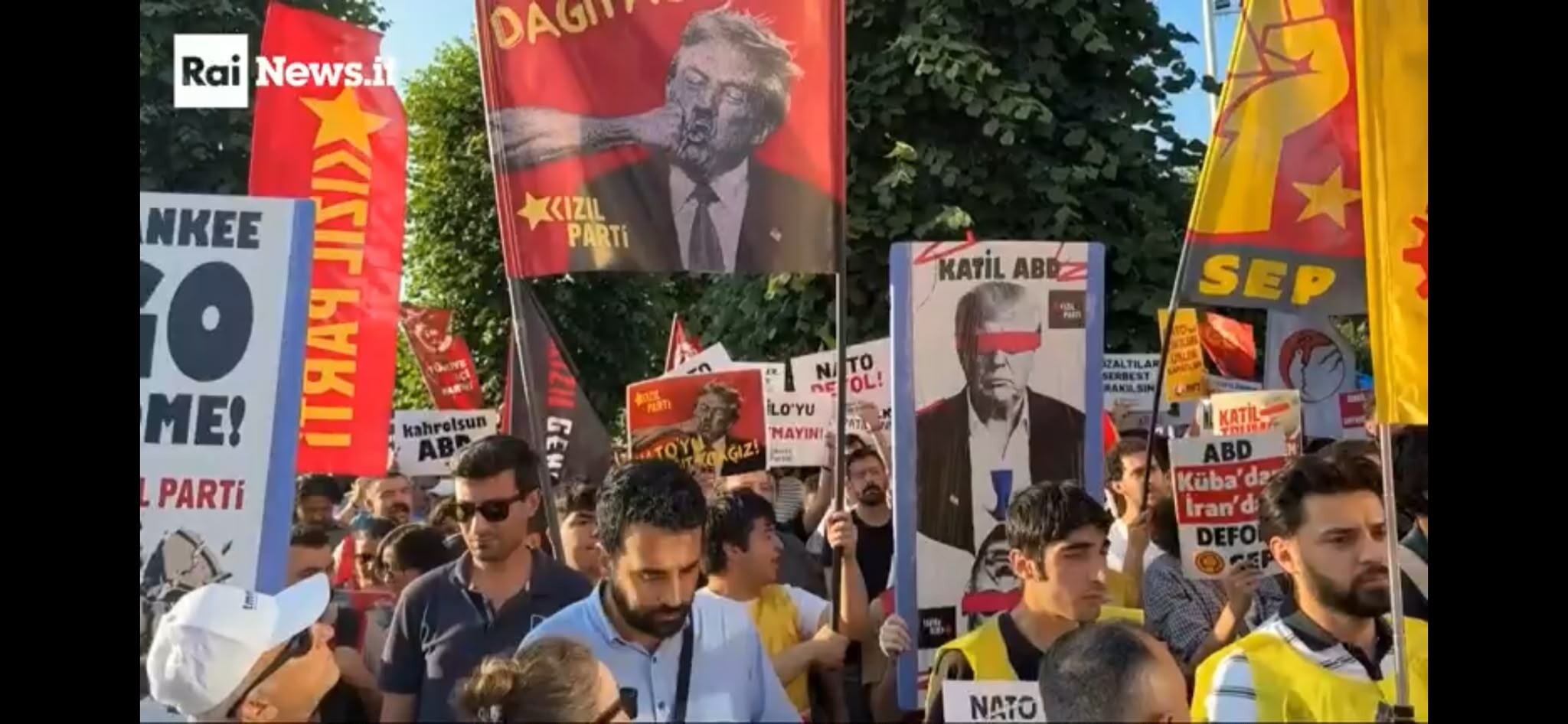 Ankara, 8 July 2026 – As the leaders of the 32 member countries of Nato gather in Ankara for the 36th summit of heads of state and government, protests erupt in Turkish squares from those who feel oppressed and forgotten. "Killer Nato, go away" – shouted the protesters. The images accompanying this article, taken from a Rainews video, tell the story of the protest. They express a deep and layered discontent, rooted in decades of military policies, in an authoritarian repression of dissent, and in an increasingly widespread perception of Nato as a tool of domination rather than a defender of democracy and freedom.
Turkey is classified as a "not free" country by Freedom House, with a score of 33 out of 100 for political rights and civil liberties. Regarding press freedom, Reporters Without Borders (RSF) ranks Turkey 163rd out of 180 countries. [1, 2]
"Killer Nato, go away"
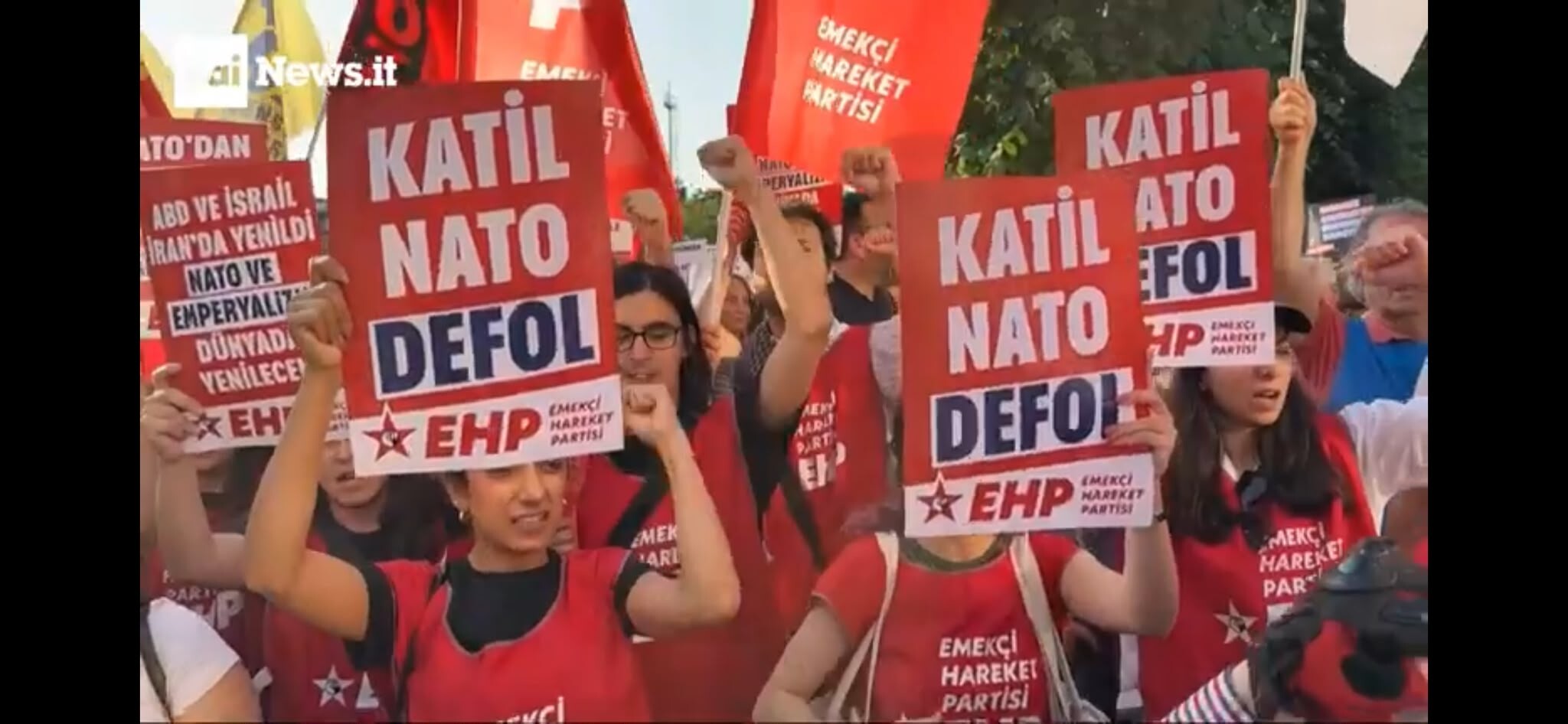
In Istanbul, the "Platform for Labour, Peace and Democracy" (Emek, Barış ve Demokrasi Güçleri) mobilised thousands of protesters, who gathered in front of the Atatürk Cultural Centre in Taksim Square before marching towards the Dolmabahçe Palace. The banners and chants forcefully conveyed messages that left no room for interpretation:
-
"Get out of NATO, dissolve NATO" (NATO'dan çık, NATO'yu yık)
-
"Nato is a terrorist organisation, it should be dissolved" (Terör örgütü NATO dağıtılsın)
-
"Killer USA, collaborator AKP" (Katil ABD, iş birlikçi AKP)
 AKP is the Justice and Development Party of Turkish President Recep Tayyip Erdoğan.
The protesters' denunciation drew a red thread connecting the Atlantic alliance, the United States, and President Erdoğan's government, accused of being a "collaborator" of imperialism. This accusation has become even heavier in light of NATO and US support for Israel in the ongoing armed conflict: in Kızılay, two activists who identified themselves as "friends of Palestine" were arrested while shouting slogans against the summit. In their defence, the "Palestinian Causes" association stated: "If you are looking for a culprit, arrest Trump".
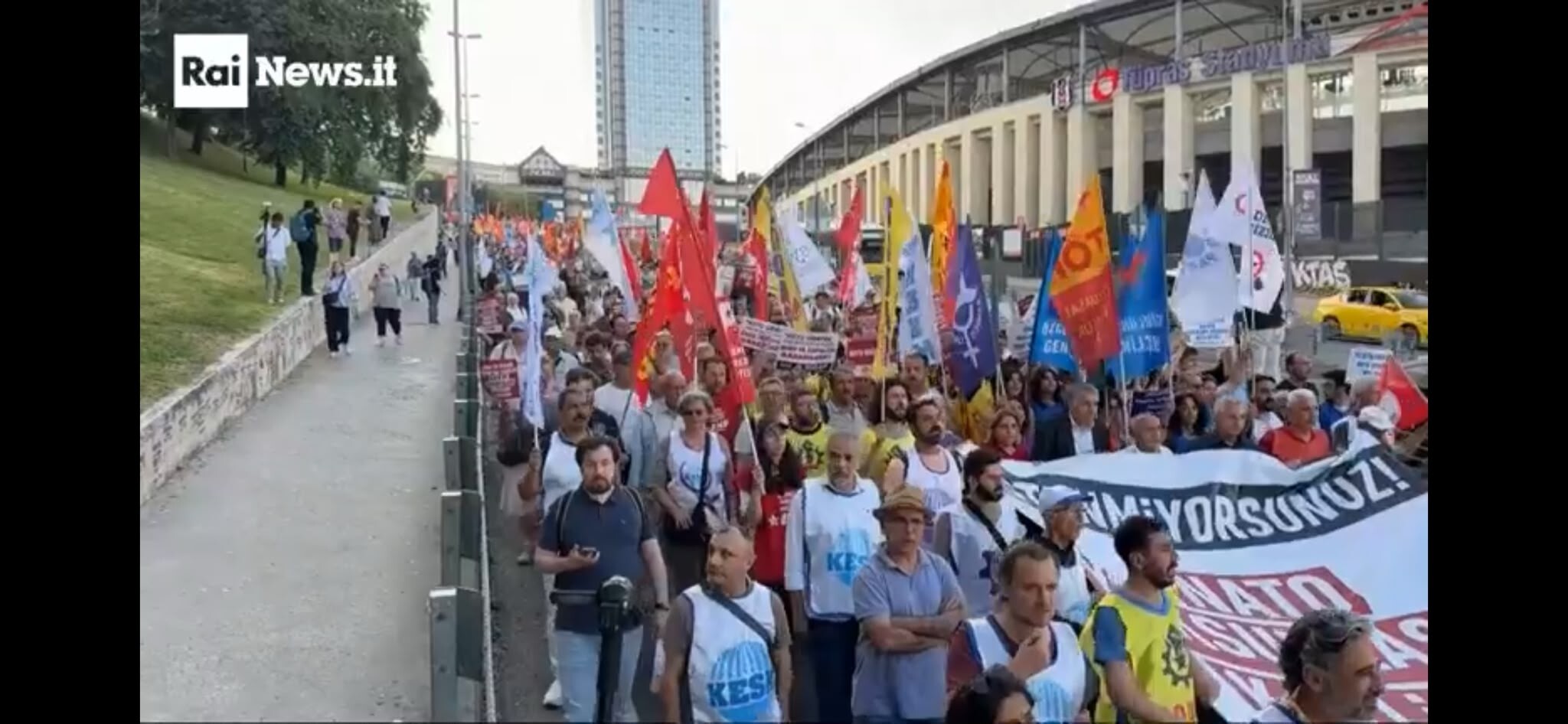
The protesters also called for the closure of the Kurecik radar base, described as "Israel's shield", and denounced NATO's role in preparing "new fronts of war" in the Middle East and beyond.
For the protesters, NATO is not a tool of collective defence, but the "gendarme of capitalism and imperialism under the guidance of the United States". In their view, Turkey is not just an ally, but a "collaborator" in an alliance that brings war and destruction.
A fortified alliance and unprecedented repression
The Turkish government's response to the protests has been of a severity that has raised concerns worldwide. The government has banned all demonstrations and public events from 28 June to 10 July, turning Ankara into what has been described as an "open-air prison". This is why the protests took place in Istanbul and other cities.
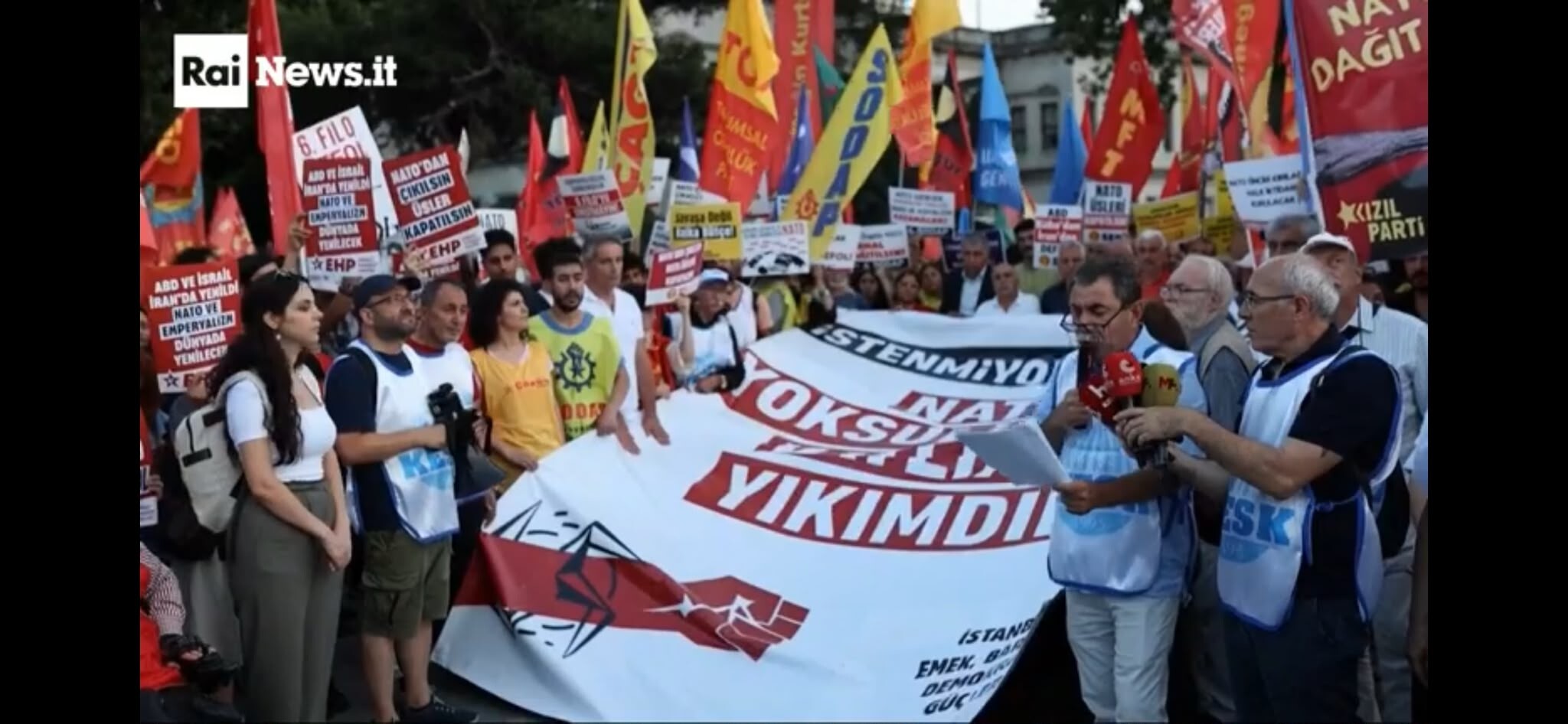
Tens of thousands of police officers have been deployed, roads closed, checkpoints imposed, and air defence put on high alert. But the repression has not been limited to security measures: in the squares, the police have made extensive use of tear gas and charges to disperse the protesters.
The numbers speak clearly and tell a story of violence and intimidation.
-
Over 100 people arrested during the Communist Party of Turkey (TKP) demonstration in Kızılay already on Sunday, 5 July.
-
About 400 activists from opposition parties and leftist organisations stopped in total during the summit days.
-
178 people ended up in pre-trial detention on charges of "terrorism".
-
Among those detained were students, trade unionists, journalists, lawyers, environmental activists, and even a comedian. Deputies from the pro-Kurdish party DEM and representatives from EMEP and TİP were detained in Ankara.
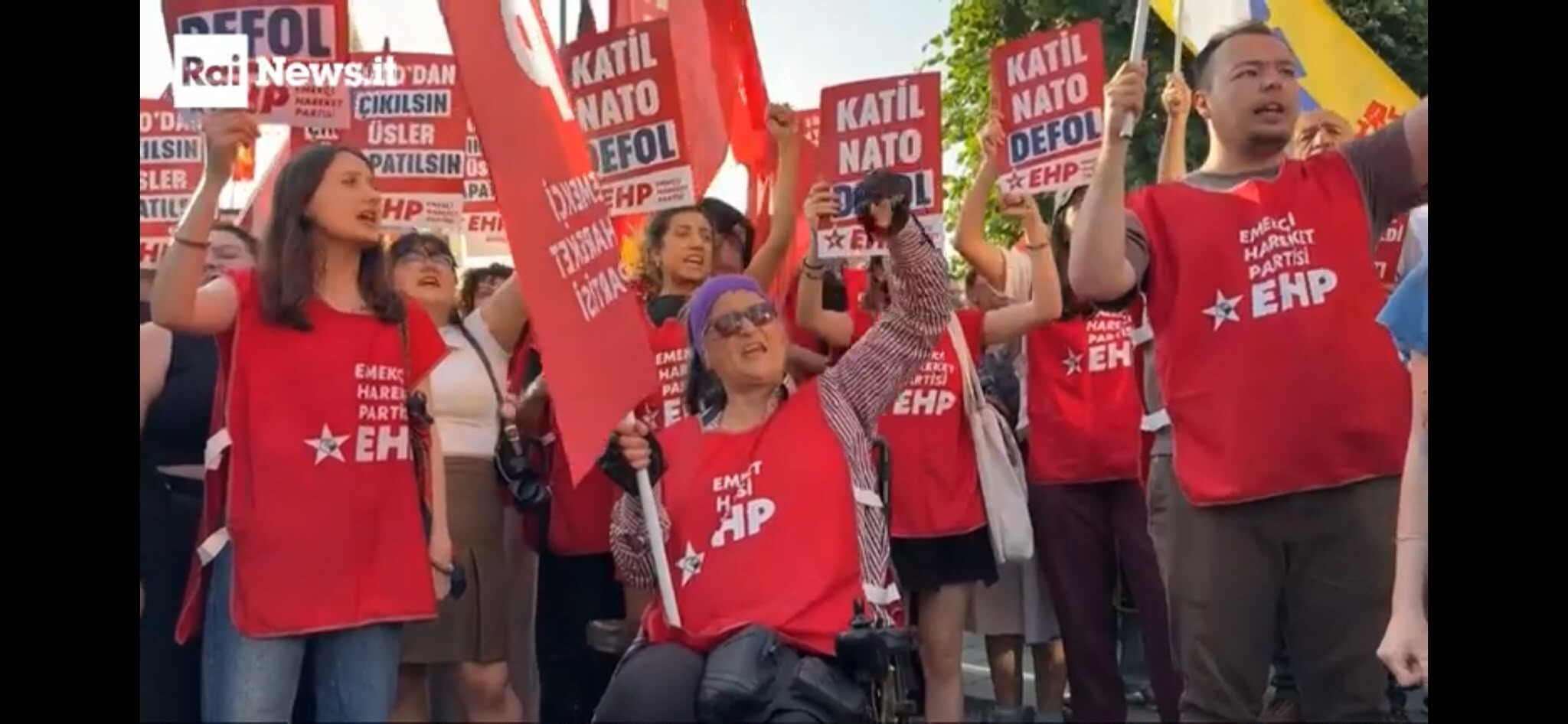
The DEM party has reported that the young people detained in Kadıköy were "subjected to torture and detention".
In Konya, a group of activists hung a banner reading "Killer Nato, go away" in a underpass, which was promptly removed by the police who launched an investigation.
The NATO Secretary General and the right to "freely protest"
A question arises: did the Atlantic Alliance issue a statement condemning the arrests and repression during the Nato summit in Ankara?
No, NATO did not publish an official statement of condemnation for the arrests and repression in Turkey during the Ankara summit. What has emerged publicly is a cautious statement from Secretary General Mark Rutte, not a formal document from the Alliance.
What did Mark Rutte say
-
On 6 July, at a press conference in Ankara, Rutte was asked about anti-terrorism raids, bans on demonstrations, and the denial of accreditation to independent journalists.
-
He responded by stating that «the right to hold demonstrations and media freedom are essential in democracies» and that democracy «is much more than just free elections», emphasising the importance of media being able to «cover major events live».
-
However, he did not explicitly condemn the mass arrests, nor the 13-day ban on demonstrations, nor the detention of comedians, activists, and journalists.
Reactions from other organisations
-
Human Rights Watch condemned Turkey's "ruthless intolerance towards freedom of expression and assembly", linking the arrests to the NATO summit.
-
Amnesty International and journalist associations have criticised NATO for delegating the selection of accreditations to Ankara, allowing the exclusion of independent media outlets.
-
Various European and Italian leftist organisations expressed solidarity with the arrested and called on NATO to take a stand, but without achieving a statement of condemnation from the Alliance.
Diplomatic context
-
NATO has stated that it depends on Turkish authorities for the accreditation of Turkish journalists, merely stating that it is «very important for NATO that the media can participate in major events».
-
At a summit hosted by a member, the practice is to avoid direct public criticism of the host country, especially on internal security issues. This explains Rutte's cautious tone and the absence of a formal condemnation document.
In summary: NATO did not issue a statement of condemnation regarding the arrests and repression in Turkey.
Therefore, the statements of NATO Secretary General Mark Rutte, who stated that "democracy also implies that people can protest freely", sound hollow in light of the reality of the facts. Human Rights Watch's denunciation was much harsher, emphasising how the misuse of anti-terrorism laws to silence the population "contradicts the founding values of the Alliance".
Turkey-Nato: an increasingly strained strategic marriage
Turkey has been a NATO member since 1952 and hosts the second largest army in the Alliance. Its geographical position, at the crossroads of Europe, Asia, and the Middle East, makes it a crucial strategic ally. However, in recent years, President Erdoğan has leveraged his position within the Alliance to pursue an increasingly autonomous foreign policy, often in open conflict with Washington and Brussels.
The purchase of the Russian S-400 missile system, which has caused significant tensions with the United States, is the most glaring example. But the list is long: military operations in northern Syria against US-backed Kurdish militias, disputes with Greece over maritime boundaries, the veto on Sweden and Finland's membership in the Alliance.
The Kurdish issue and the security knot
A central element of the protests, and more generally of Turkish internal politics, is the Kurdish issue. Turkey considers the Kurdistan Workers' Party (PKK) to be a terrorist organisation. The Turkish armed forces have conducted numerous military operations against Kurdish militias in Turkey, Iraq, and Syria.
For many Kurds and leftist forces, NATO is perceived as an alliance that, by supporting Ankara's interests, contributes to perpetuating the conflict and repression against the Kurdish people. The voices shouting "Nato, go away" blend with those calling for an end to military operations and respect for minority rights.
The government's choice to use "anti-terrorism" laws to justify mass arrests during the protests has further exacerbated this perception, turning the security of the summit into a tool for repressing political dissent. Among those detained, as we have seen, were deputies from the pro-Kurdish DEM party, indicating that the repression has also affected popular representation in institutions.
The spectre of war and the weight of armaments
The Ankara summit took place in a climate of heightened international tension. The leaders of the 32 member countries discussed increasing defence spending, aiming to reach 5% of GDP by 2035, a demand strongly pushed by Washington. They also reiterated support for Ukraine and discussed strategies to counter Russia and China.
But for the protest movements, NATO is perceived as "the bloody organ of imperialism", an alliance that brings "destruction, war, and death" wherever it goes. The protests, therefore, were not just a street phenomenon, but an expression of deep political and social dissent against the foreign policy choices and alliances of the Turkish government.
This dissent has also found a voice among the younger generation. In Izmir, Çanakkale, and Samsun, students and workers marched together, uniting their voices in a chorus calling for peace, social justice, and sovereignty. "This country is ours", they shouted. "Nato go away".
Leading the mobilisations were parties and organisations such as the Communist Party of Turkey (TKP), the Socialist Workers' Party (SEP), and youth collectives like the "Youth Union against NATO and imperialist war".
Reflections
The images accompanying this article are the visual testimony of a peaceful uprising that deserves to be told. But beyond the facts, there are some questions that as peace activists we are called to ask:
-
The price of alliance: how far is the West willing to tolerate the authoritarian drift of an ally in order to maintain a strategic advantage? Is NATO an alliance of values or merely of interests?
-
Is NATO really defensive? For many Turks, and particularly for Kurds, NATO represents an offensive alliance that threatens their security and rights. Is it not time to question this perception of NATO that mobilises so many people?
-
Militarisation as a social problem: the request from NATO to increase defence spending to 5% of GDP is not just a foreign policy choice, but has a direct impact on people's lives, diverting resources from health, education, and welfare. Is this the priority for the peoples?
The voices that in Turkey have shouted "Killer Nato, go away" are voices that call for peace, democracy, and justice. They are voices that, in a historical moment marked by wars and conflicts, deserve to be amplified worldwide because they are popular voices that Erdoğan's regime seeks to silence.
Sources: Evrensel, Halk TV, Kuzey Ege Haber, Artı Gerçek, Cumhuriyet, Chosun Ilbo, China Daily, Jerusalem Post, Sky TG24, Haber Dairesi, Reuters.
Rutte's blessing and the violation of international law
While the protests in the squares shouted "Nato assassin, go away", the words of the Secretary General of the Alliance, Mark Rutte, offered them a bitter confirmation. At the opening of the Ankara summit, Rutte indeed expressed his full support for the new military attacks launched by Trump against Iran, calling them "absolutely necessary".
"When you have a ceasefire and Iran is essentially violating it – we saw what happened yesterday with the attacked ships – I think it is totally crucial that the United States reacts strongly", Rutte stated to journalists before the summit. The Secretary General also praised Donald Trump for pushing NATO allies to increase defence spending, calling the commitment of Europeans and Canadians a "great victory" for the alliance.
These statements, however, clash head-on with the fundamental principles of international law and with the very United Nations Charter that NATO claims to honour. Article 2, paragraph 4 of the UN Charter explicitly prohibits "the threat or use of force against the territorial integrity or political independence of any state". The unilateral attacks by the United States against Iran, which targeted over 80 military sites and around sixty ships in the Strait of Hormuz, cannot be framed within the legitimate self-defence provided for in Article 51 of the Charter, which requires the existence of an ongoing armed attack and adherence to the principle of proportionality.
Not surprisingly, international legal experts and various critical voices have pointed out that the US-Israel campaign against Iran violates the UN Charter and lacks a valid justification under international law. The Iranian ambassador to the United Nations spoke of "a flagrant violation of the UN Charter", while Russia denounced "another act of unprovoked armed aggression against a sovereign and independent member state".
The contradiction with the Atlantic Treaty
Rutte's position appears to be in stark contradiction with the very Preamble of the North Atlantic Treaty, which underpins the very existence of the Alliance. The Treaty indeed opens with the solemn affirmation that the signatory parties "reaffirm their faith in the purposes and principles of the UN Charter and their desire to live in peace with all peoples and all governments".
Supporting and legitimising a unilateral military action that violates the UN Charter means betraying the spirit and letter of NATO's founding pact. It means transforming the Alliance from a tool of collective defence, born to counter aggression, into a subject that legitimises and encourages others' aggression, bypassing the United Nations Security Council and the norms governing international relations.
Rutte's words reveal a clear choice: to side unreservedly with the United States, even when they act in blatant violation of international law. A choice that undermines the very foundations of the world order based on shared rules. It is therefore not surprising that Iran has accused NATO of "complicity" in the US-Israel war, speaking of "flagrant violations of the imperative norms of international law and the fundamental principles of the UN Charter".
Additional sources for this section
-
Reuters: reports Rutte's statements on the "absolutely necessary" attacks.
-
Gulf News: highlights how Rutte called the attacks "absolutely necessary" after the attacks on the ships.
-
NATO Watch: documents the consensus among legal experts on the violation of Article 2(4) of the UN Charter by the US-Israel campaign.
-
Vietnam.vn: cites Rutte's words on the need for a "strong US reaction".
-
Asianet Newsable: reports Rutte's statement on Iran's violation of the ceasefire.
Why did the most important Turkish demonstration against the NATO summit take place in Istanbul and not in Ankara where the summit was held?
The demonstration was called in Istanbul rather than Ankara due to a combination of political, symbolic, and logistical factors:
1. Bans and repression in Ankara
-
In anticipation of the NATO summit on 7–8 July 2026, Turkish authorities banned public gatherings in Ankara and reinforced security measures in the capital, where the summit is taking place.
-
In the week prior, the government conducted a campaign of arrests against activists, independent journalists, and political opponents, using anti-terrorism laws to block mobilization.
-
Under these conditions, organising a large march in Ankara would have been nearly impossible: the police would have immediately dispersed the protesters.
2. Istanbul as the "capital of protests"
-
Istanbul has a historical tradition of large popular mobilisations (Gezi Park 2013, 1st May, protests against the US Sixth Fleet in 1968). The Taksim–Dolmabahçe route is a national symbol of popular struggle.
-
The city is the media and cultural centre of Turkey: a demonstration there guarantees greater internal and international visibility compared to Ankara, which is more isolated and controlled during summits.
3. Strategies of the organisers
-
The forces united in “İstanbul Emek, Barış ve Demokrasi Güçleri” (including TKP and other leftist groups) chose Istanbul to overcome the state blockade and connect the local protest to a broader anti-NATO agenda internationally. Some anti-NATO initiatives had already been organised in Istanbul in the days leading up to the summit (4–5 July).
-
The choice of Istanbul also allows for coordination with other cities (Izmir, Antalya, Diyarbakır) where parallel protests have been organised, creating a national mobilisation network.
4. Logistics and security
-
In Ankara, during the summit, the capital was closed and militarised: red zones, roadblocks, massive controls. Even if the protest had been authorised, it would have been heavily restricted.
-
Istanbul, on the other hand, offers wider spaces and a proven capacity for mobilisation of thousands of people, albeit with risks of repression.
In summary: Ankara was the seat of power, but Istanbul was the seat of protest. The choice reflects the strategy of exploiting the historical-political symbol of Taksim–Dolmabahçe, circumventing the bans and the repressive grip on the capital.
Articoli correlati
 Albert, international pacifist bulletin
Ukraine: the uprising of the squares against the military "meat grinder"
The sacking of popular Defence Minister Fedorov has sparked unprecedented protests in Kyiv and other Ukrainian cities. At the heart of the anger from protesters and the families of soldiers is the strategy of Commander-in-Chief Syrskyi, accused of sacrificing too many human lives.18 July 2026 - Redazione PeaceLink- Albert, bollettino pacifista internazionale
Ucraina: la rivolta delle piazze contro il "tritacarne" militare
Il siluramento del popolare ministro della Difesa Fedorov accende proteste senza precedenti a Kiev e in altre città ucraine. Al centro della rabbia dei manifestanti e dei familiari dei soldati c'è la strategia del Comandante in Capo Syrskyi, accusato di sacrificare troppe vite umane.18 July 2026 - Redazione PeaceLink  Il caso del generale Grynkewic, Comandante Supremo della NATO in Europa
Se i generali frenano la psicosi bellica dei politici
Il ministro della Difesa tedesco, il socialdemocratico Pistorius, ha ipotizzato davanti al parlamento un attacco russo all’Europa entro il 2029. Per Macron occorre essere pronti anche a “versare il sangue”. Ma il generale che comanda la NATO europea smentisce tutti con i dati dell’intelligence.17 July 2026 - Redazione PeaceLink Albert, international pacifist bulletin
Gaza, July 2026: the crisis continues amid bombings, hunger, and impunity
As of 17 July 2026, the most reliable quantitative data indicates that the overall Palestinian death toll in the Gaza Strip exceeds 73,000 dead and 173,000 injured since the start of the war on 7 October 2023. In July, the list of journalists killed in Gaza has grown longer.17 July 2026 - PeaceLink staff


sociale.network