What happened in the world in May and what positive actions can we take in June
Albert – June 2026
International Bulletin for Peace and Disarmament
This bulletin is aimed at those who still believe that another world is possible.
Unfortunately, it is published at one of the darkest moments in recent history, but also with some glimmers of hope that we must continue to nurture. The Doomsday Clock is set at 85 seconds to midnight. Never so close to the abyss. Nuclear powers are modernising their arsenals. Military conflicts are tearing apart entire regions of the world, often under the complicit silence of nations profiting from it, and the case of Sudan is emblematic. However, there are historical processes and civil society movements that are building strategies for peace, cooperation, and denuclearisation.
This bulletin tells both sides of our contemporary reality: the normalised horror and the silent but concrete resistance.
1. Sudan – The "forgotten war" enters an even more lethal phase
1.1 - What has happened
15 April 2026 marked three years of war between the Sudanese Armed Forces (SAF) and the Rapid Support Forces (RSF). Since then, Sudan has become the world's most severe humanitarian crisis, but media attention is focused elsewhere. UNICEF has raised the alarm: in the first three months of 2026 alone, at least 160 children killed and 85 injured; in El Fasher alone, more than 1,300 children killed by drones and explosives. Over 11 million internally displaced people and nearly 5 million refugees across borders. 28.9 million people in severe food insecurity.
The month of May in Sudan has been a month of intensification of conflict on multiple fronts. Diplomacy has tried to rekindle hopes for peace, but on the other side, fighting, the humanitarian crisis, and regional tensions have painted a picture of deep suffering for the civilian population.
A series of drone attacks in North Darfur killed at least 19 civilians. In recent episodes of drone attacks, civilian tolls have been very high: for example, in Kutum on 9 April, there were reports of at least 30 civilian deaths, and a UN report from May indicated that at least 880 civilians had been killed by drone attacks in Sudan between January and April 2026.
The Sudanese government accused Ethiopia and the United Arab Emirates of launching drone attacks since March on various states across Sudan from within Ethiopian territory, including attacks on Monday against the capital Khartoum and its civilian airport. The UAE has been accused of arming the RSF, but Ethiopia has denied hosting RSF and UAE forces on its territory.
1.2 - What is happening
The conflict has entered an even more lethal phase due to the massive use of drones. The RSF now controls all the cities in Darfur and is preparing for a decisive battle. The SAF, for their part, are amassing troops in Kordofan and Blue Nile. External powers continue their deadly game: Egypt, Saudi Arabia, and Turkey support the Sudanese Armed Forces (SAF); the UAE provides weapons to the RSF in exchange for blood gold. Overwhelming evidence, but no international sanctions.
1.3 - Prospects and our commitment
The Berlin conference in April 2026 failed: 1.5 billion euros in aid promises were raised, but no ceasefire. The so-called “Berlin Principles” avoid naming those responsible. The international community is divided and distracted. The Berlin Principles for Sudan are a document signed by an international coalition on 30 April 2026, serving as a sort of “roadmap” agreed upon to end the civil war in Sudan. While not legally binding for the parties in conflict, they constitute the basis for a common international position for a peaceful and lasting resolution of the conflict. But the international community is divided and distracted.
It must be said: enough silence. And we ask European governments to:
- impose immediate sanctions against the United Arab Emirates for their active role in the conflict;
- support UNICEF's appeal with the necessary funds (currently only 16% funded);
- promote a diplomatic initiative independent of the EU, without waiting for the failing Quad (USA, Egypt, Saudi Arabia, UAE).
And we ask you, reader, not to look away from this tragedy. Sudan exists. Its children exist.
2. Gaza – A ceasefire only on paper
2.1 - What has happened
In May 2026, the official death toll from the genocide in Gaza reached 72,939 dead and 172,927 injured since October 2023. Since the “ceasefire” was signed (11 October 2025), at least 930 people have been killed, peaking at 33 deaths during Eid al-Adha. The Israeli army now controls 60% of the territory, and Netanyahu has announced plans to reach 70%.
2.2 - What is happening
Humanitarian aid is entering at only 25% of what was agreed. Hospitals are collapsing, drinking water is scarce, and the risk of fires in the tents of the displaced is extremely high. The Global Sumud Flotilla (54 boats, 428 activists) was intercepted in international waters by the Israeli navy on 19 May; the activists were arrested by Israeli military forces, and the flotilla was seized in an act of piracy directed by Tel Aviv, in violation of international law.
The International Court of Justice (ICJ) has ordered Israel to stop the offensive on Rafah. Israel has responded with a defiant attitude. The International Criminal Court (ICC) - but these are just rumours - may issue arrest warrants for high-ranking Israeli officials (Katz, Smotrich, Ben-Gvir, Zamir, Asor).
- The rumours and the denial: in mid-May, the Israeli newspaper Haaretz reported an alleged request from the ICC Prosecutor to issue secret warrants for ministers Bezalel Smotrich and Itamar Ben-Gvir, for another government official (Orit Strook) and for two IDF officers. However, the Hague Court immediately denied these reports, confirming that no new warrants have been issued against other Israeli leaders beyond those already made public for Benjamin Netanyahu and Yoav Gallant. [1, 2, 3, 4]
- The Israeli reactions: the voices of possible warrants have triggered severe reactions in Israel. Finance Minister Smotrich called the possibility a "declaration of war", responding to the announcement with the approval of orders for the evacuation of the Bedouin village of Khan al-Ahmar. [1, 2]
- Context: the proceedings under consideration by the ICC concern alleged war crimes and crimes against humanity, including developments related to settlements in the West Bank and the management of the armed conflict in Gaza. [1, 2, 3]
The situation remains fluid.
2.3 - Prospects and our commitment
Europe has sanctioned (finally, but timidly) some violent settlers in the West Bank. But it has not suspended the association agreement with Israel, nor has it stopped trading arms.
We must demand:
- economic and military sanctions against Israel until it complies with the orders of the International Court of Justice;
- immediate recognition of the State of Palestine by all European countries that have not yet done so;
- the reopening of the Rafah crossing and unhindered entry of aid.
We must also support the upcoming Flotilla. The Israeli naval blockade is a violation of international law. It must be broken.
3. Nuclear – Arms race and normalisation of the Apocalypse
3.1 - What has happened
On 5 February 2026, the New START Treaty between the USA and Russia for long-range nuclear missiles expired. For the first time since the end of the Cold War, there is no legally binding limit on the arsenals of the two major nuclear powers. The INF Treaty (intermediate-range nuclear missiles in Europe) had already collapsed in 2019.
From 27 April to 22 May 2026, the 11th Review Conference of the Non-Proliferation Treaty (NPT) was held in New York. It failed. The main responsibility lies with the United States as Trump boycotted any initiative that fell under the UN umbrella, refusing even to discuss disarmament.
3.2 - What is happening
NATO is preparing a large nuclear exercise. In October 2026, NATO will hold the nuclear exercise “Steadfast Noon”, one of the largest since the end of the Cold War. The exercise simulates the use of tactical nuclear weapons by NATO.
No national parliament has discussed and voted on these exercises. Nuclear launch decisions can be made in 10 minutes, without any democratic oversight. The end of the world could occur in ten minutes due to a discretionary choice that escapes any parliament.
3.3 - Prospects and our commitment
Africa, as we will see, shows the alternative path. But in Europe, the atomic conscience seems to have evaporated.
We must demand:
- prior parliamentary discussion of the Steadfast Noon nuclear exercise;
- a strategy that subordinates any use or training for the use of nuclear weapons to prior parliamentary vote;
- adherence to the Treaty on the Prohibition of Nuclear Weapons (TPNW), and the removal of B61 bombs from US and NATO bases;
- a simultaneous initiative in European squares against Steadfast Noon: as in the 1980s, millions of people must say “never again”.
4. Africa – A continent that says “no” to nuclear
4.1 - What has happened
The Pelindaba Treaty makes Africa the largest nuclear-weapon-free zone in the world (54 countries).
Ghana ratified the TPNW in 2025, which came into force in March 2026. On 27 January 2026, it hosted the West and Central Africa Regional Conference in Accra, with 22 countries, organised with Austria, ICAN, and the Red Cross. A joint declaration was approved committing countries to accelerate ratifications of the TPNW and to reject any “nuclear-sharing” agreements on African territory.
4.2 - What is happening
African nations are pushing for nuclear disarmament. The continent has declared itself a nuclear-weapon-free zone with the Pelindaba Treaty, and many African capitals have also joined the TPNW, the treaty that bans atomic bombs.
South Africa will host the first Review Conference of the TPNW in November this year. African nations have explicitly condemned nuclear-sharing at the UN (involving Italy, Germany, Belgium, the Netherlands, Turkey) as incompatible with the NPT, that is, the treaty on nuclear non-proliferation.
The nuclear sharing is instead a NATO system in which some US nuclear bombs are deployed in non-nuclear-armed allied countries, such as Italy, Germany, Belgium, the Netherlands, and Turkey; however, they remain under US control, while the host countries participate in planning and exercises.
4.3 - Prospects and our commitment
Africa shows that a world without nuclear weapons is possible. European nations must learn from this example and participate in the first Review Conference of the TPNW that will take place in November in South Africa.
We must support the campaign for the universalisation of the TPNW led by Ghana and South Africa and the request from African nations to end nuclear-sharing. We must ask Western governments why they continue to host nuclear bombs in various European nations.
5. ZOPACAS – The South Atlantic, a zone of peace and cooperation
5.1 - What has happened
On 8-9 April 2026, the 24 countries of the South Atlantic Peace and Cooperation Zone (ZOPACAS) – Brazil, Argentina, Uruguay, and 21 nations on the west coast of Africa – met in Rio de Janeiro (IX ministerial meeting). Brazil has assumed the presidency for the next two years. Three documents were signed: a convention on the marine environment, a cooperation strategy on 14 thematic areas, and - very importantly - a political declaration reaffirming the denuclearisation of the region and condemning extraregional interference.
5.2 - What is happening
After the IX Ministerial Meeting in April 2026, ZOPACAS seems to have entered a new and more operational phase compared to the past. For the first time, a proper Rio de Janeiro Cooperation Strategy has been adopted, which should guide joint work until 2028-2029 under Brazilian presidency.
The planned initiatives mainly concern eleven priority areas of cooperation, including:
- maritime security and defence;
- fighting piracy, illicit trafficking, and illegal fishing;
- oceanographic research;
- climate change;
- protection of marine biodiversity;
- food security and sustainable fishing;
- protection of critical infrastructure;
- connectivity and logistical integration between Africa and South America;
- technical training and skills exchange.
5.3 - Prospects and our commitment
The Rio Declaration reaffirms:
- the will to keep the South Atlantic free from nuclear weapons and other weapons of mass destruction;
- the rejection of the militarisation of the region;
- the opposition to the importation of external geopolitical rivalries into the South Atlantic.
The South Atlantic is a model of South-South cooperation, and we must ask parliaments and the European Union to diplomatically support the ZOPACAS strategy.
Conclusion: our commitment for the coming months
This bulletin is not just a report. It is a call to mobilise.
- There will be a large European peace demonstration in Brussels on Saturday 14 June 2026. The event, promoted by international networks including the IPB (International Peace Bureau) and various civil society movements, will take place under the slogan "Welfare not Warfare"
- October 2026: we must prepare a European mobilisation against the Steadfast Noon nuclear exercise. Let us return to the squares as in the 1980s.
- November 2026: TPNW Review Conference in New York. Let us support South Africa and Ghana. We call on European nations to participate.
- Every day: let us not forget Gaza. Let us denounce Israel. Let us denounce Western hypocrisy.
- Let us not forget Sudan. Let us denounce the role of the United Arab Emirates.
- Let us promote seminars and assemblies on the risk of nuclear war inviting ambassadors from nations that have taken a stand for nuclear disarmament. The world has never been so close to catastrophe. But never before have there been concrete alternatives: a denuclearised Africa, the South Atlantic as a zone of peace, the TPNW growing.
It is up to us to choose which side to be on.
For peace, for disarmament, for a future of justice, for a present of solidarity.
Albert, 2 June 2026
Attachments
Sudan
Albert
Source: PeaceLink176 Kb - Format pdfUpdated on 2 June 2026Gaza
Albert
Source: PeaceLink130 Kb - Format pdfUpdated on 2 June 2026Risk of nuclear war
Albert
Source: PeaceLink249 Kb - Format pdfCritical paper on the incompatibility of atomic weapons (and of the "first strike" nuclear attack) with democracy
See also
 I partecipanti avranno tempo fino al 1° novembre 2026 per presentare video di attivismo per la pace
Peace Wave 2026
L'annuale iniziativa multimediale che racchiuderà i clip video via via inviati dagli attivisti. Un incontro finale via Zoom li diffonderà lungo il corso delle 24 ore seguendo il movimento del Sole intorno alla Terra.2 June 2026 - Roberto Del Bianco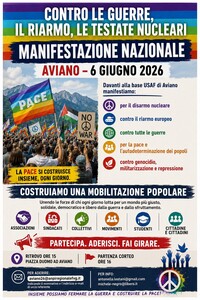 Aviano una voce collettiva per la pace
Il 6 giugno manifestazione nazionale davanti alla base USAF di Aviano
Contro le guerre, il riarmo, le testate nucleari. Comunicato stampa di ANPI, CGIL e numerose realtà sociali e pacifiste che promuovono una mobilitazione unitaria e nonviolenta contro l’escalation militare globale.26 May 2026 - Redazione PeaceLink


Articoli correlati
 Albert, international pacifist bulletin
Ukraine: the uprising of the squares against the military "meat grinder"
The sacking of popular Defence Minister Fedorov has sparked unprecedented protests in Kyiv and other Ukrainian cities. At the heart of the anger from protesters and the families of soldiers is the strategy of Commander-in-Chief Syrskyi, accused of sacrificing too many human lives.18 luglio 2026 - Redazione PeaceLink- Albert, bollettino pacifista internazionale
Ucraina: la rivolta delle piazze contro il "tritacarne" militare
Il siluramento del popolare ministro della Difesa Fedorov accende proteste senza precedenti a Kiev e in altre città ucraine. Al centro della rabbia dei manifestanti e dei familiari dei soldati c'è la strategia del Comandante in Capo Syrskyi, accusato di sacrificare troppe vite umane.18 luglio 2026 - Redazione PeaceLink  Il caso del generale Grynkewic, Comandante Supremo della NATO in Europa
Se i generali frenano la psicosi bellica dei politici
Il ministro della Difesa tedesco, il socialdemocratico Pistorius, ha ipotizzato davanti al parlamento un attacco russo all’Europa entro il 2029. Per Macron occorre essere pronti anche a “versare il sangue”. Ma il generale che comanda la NATO europea smentisce tutti con i dati dell’intelligence.17 luglio 2026 - Redazione PeaceLink Albert, international pacifist bulletin
Gaza, July 2026: the crisis continues amid bombings, hunger, and impunity
As of 17 July 2026, the most reliable quantitative data indicates that the overall Palestinian death toll in the Gaza Strip exceeds 73,000 dead and 173,000 injured since the start of the war on 7 October 2023. In July, the list of journalists killed in Gaza has grown longer.17 luglio 2026 - PeaceLink staff


sociale.network